October 2026 | Unexpected Ancestors | Mason Family
By Susan Jepson Lenski
Connection: Richard Warren was my 11th great-grandfather.
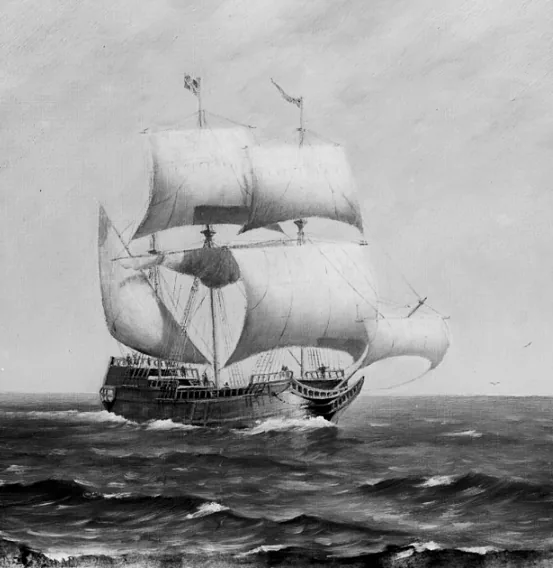
The Mayflower, by Charles Austin Needham, c. 1900–1920.
Courtesy of the Library of Congress.
“Stranger” on the Mayflower
When people discover they have a Mayflower ancestor, they often imagine a devout Pilgrim fleeing religious persecution and seeking freedom in the New World.
That isn’t quite the story of my Mayflower ancestor.
Our ancestor, Richard Warren, came on the Mayflower in 1620, but he was not one of the Separatists we usually call the Pilgrims. Instead, he was one of the “Strangers”—the merchants, craftsmen, laborers, and other settlers who joined the voyage for practical and economic reasons. In many ways, his story reminds us that America was founded not only by people seeking religious freedom, but also by people seeking opportunity.
The Voyage Everyone Knows—But Few Know Well
Most Americans have heard of the Mayflower.
We picture a small ship crossing the Atlantic, a Thanksgiving feast, and the beginnings of Plymouth Colony.
The reality was far more difficult.
The Mayflower left England in September 1620 carrying 102 passengers. It was not designed to carry families across an ocean. For more than two months the passengers endured storms, cramped quarters, seasickness, and uncertainty. When they finally reached North America in November, they found themselves far north of their intended destination. Instead of settling near the Hudson River, they anchored at Cape Cod and began searching for a place to establish a colony.
Nearly half the settlers would die during the first winter.
No one aboard knew whether the venture would succeed.
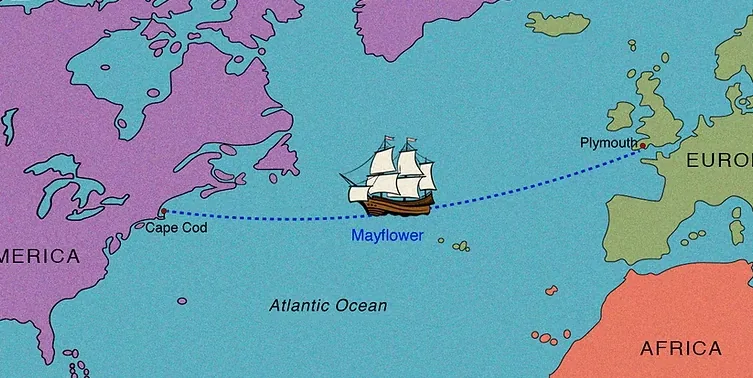
Map of the voyage of the Mayflower.
Why Richard Warren Came
The Pilgrims had religious reasons for coming to America.
Richard Warren had different motivations.
He was a merchant from England who was recruited by the Merchant Adventurers, the group of London investors who financed the colony. Those investors expected a return on their money through trade and economic development in the New World. Warren represented the practical business side of the Plymouth venture.
That may sound less romantic than the traditional Pilgrim story, but it was just as important.
A colony could not survive on faith alone. It needed people who could organize work, manage trade, acquire supplies, and help build a functioning economy.
William Bradford later described Richard Warren as “a most useful man” who shared deeply in the difficulties of the settlement.
Signing the Mayflower Compact
One of the most remarkable moments in American history occurred before the settlers even came ashore.
Because they had landed outside the territory governed by the Virginia Company, some passengers questioned whether any authority existed over them. To prevent disorder, the adult men aboard the ship agreed to create their own system of government.
On November 11, 1620, Richard Warren became one of the forty-one men who signed the Mayflower Compact.
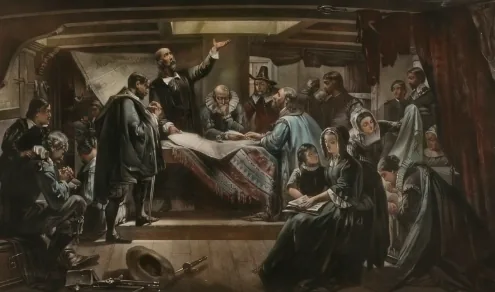
Signing of the Compact in the Cabin of the Mayflower by George E. Perine
The document was simple, but its influence was enormous. The signers agreed to govern themselves through laws created for the common good and approved by the community. Historians often view the Compact as an early step toward the American tradition of self-government.
Our ancestor was there at the beginning.
A Family That Survived
Richard Warren made the voyage alone.
His wife, Elizabeth, and their five daughters remained in England while he helped establish the colony. Several years later they joined him in Plymouth, where two sons were born.
Richard did not live long. He died in 1628, only a year after his family arrived.
Yet his greatest legacy was still ahead.
Unlike many early colonial families, all seven of Richard Warren’s children survived to adulthood, married, and raised families of their own. Through those children, Richard became one of the most widely descended of all Mayflower passengers.
That is one reason so many Americans today can trace their ancestry to Richard Warren.
In our family line, the descent runs through his daughter Elizabeth Warren and eventually to John Thomas Mason, the Massachusetts farmer who moved west to Illinois in the 1840s.
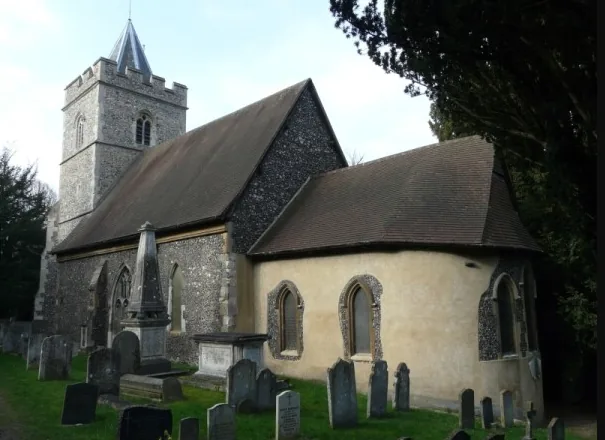
Richard Warren and Elizabeth Walker were married April 14, 1610 at the Parish Church of St. John the Baptist in Great Amwell, Hertfordshire, England.
The Part That Stays With Me
What fascinates me most about Richard Warren is that he reminds us how complicated history really is.
The popular version of the Mayflower story focuses almost entirely on the Pilgrims and their search for religious freedom.
But Plymouth Colony was also a business venture.
It required investors, merchants, craftsmen, laborers, and practical people willing to take enormous risks for uncertain rewards. Richard Warren represented that side of the story.
He crossed an ocean, survived one of the harshest beginnings in American history, signed the Mayflower Compact, helped establish a colony, and left behind a family that spread across New England and eventually into Illinois.
Four hundred years later, many of us can trace our ancestry back to him.
Not because he was famous.
Not because he was a religious leader.
But because he was willing to take a chance on an unknown future—and because all seven of his children survived to build families of their own.
Sometimes the people who shape history are not the ones we remember best. They are the ones whose descendants are still telling their stories.
Sources
This article is based on:
- Bradford, William. Bradford’s History of “Plimoth Plantation.” PDF. Project Gutenberg.
- Captivating History. The Mayflower: A Captivating Guide to a Cultural Icon in the History of the United States…Portland, OR: Captivating History, 2021.
- Haxton, Annie Arnoux. Signers of the Mayflower Compact. New York: Clearfield, 1897.
Related Reading
Subscribe to the Newsletter
Lives Behind the Records
Questions. Discoveries. Stories from Family History.
Contact: info@ancestors2illinois.com