Issue #1 — September 2026: The Mason Family
Stories of Migration, Settlement, and Family History
Issue #1 | September 2026 | Mason Family
By Susan Jepson Lenski
Lives Behind the Records. Questions. Discoveries. Stories from Family History.
What I’ve Been Wondering…
When was the last time you stood up for one of your convictions? What did it cost?
That’s the question I’ve been thinking about this month as I learned more about my ninth great-grandfather, Sampson Mason. Sampson left England in 1649 and settled in Rehoboth, Massachusetts, a community founded by Puritans. The Puritans came to America seeking the freedom to practice their faith and they expected others to conform to their beliefs. Sampson didn’t. He was a Baptist.
That choice had consequences. Most of us eventually face moments when we have to decide whether our convictions are worth the cost. For Sampson, the cost was immediate. For his family, the consequences lasted for generations. As I read about his life, I found myself wondering what I would have done. I honestly don’t know.
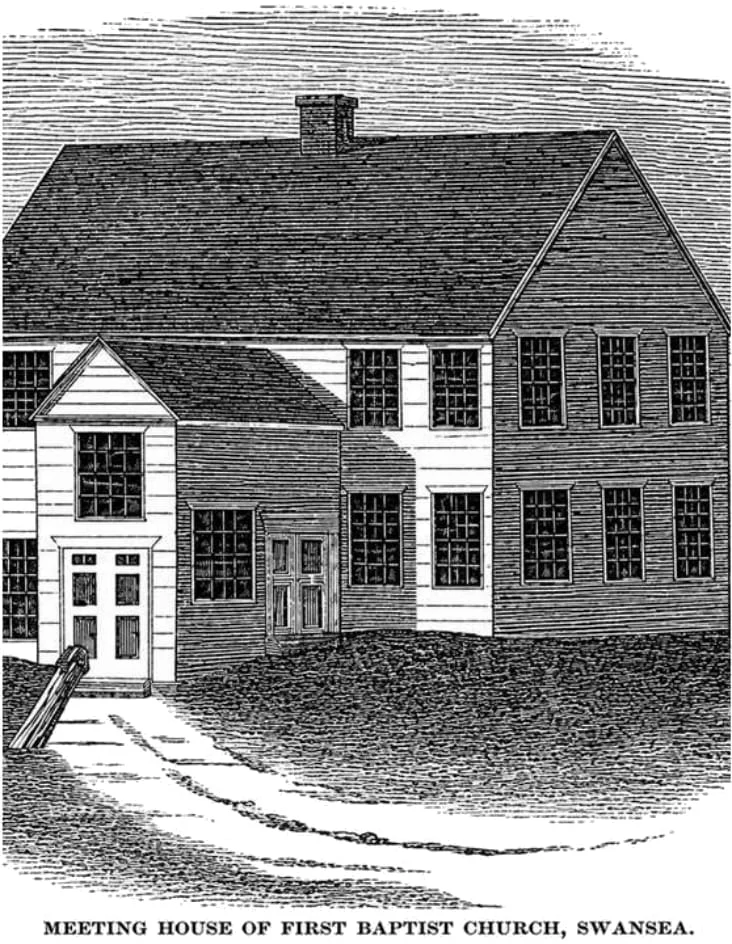
In 1663, Sampson Mason helped establish the Baptist congregation that worshiped in Swansea.
How We’re Connected
Sampson Mason was my ninth great-grandfather. My connection comes through my father, David Jepson, and my grandmother, Edna Mae (Mason) Jepson.
A Window Into Sampson’s World
Sampson Mason grew up in Bolton, Lancashire, a town where the Puritan religion shaped almost every part of life. People were expected to worship in approved ways, and belonging to the community meant sharing its beliefs. At some point, Sampson embraced a different faith. He became a Baptist. That decision would have set him apart from many of his neighbors. Baptists believed that faith should be a personal choice, that only believers should be baptized, and that government should not dictate matters of conscience.
Sampson served as a dragoon in Oliver Cromwell’s army. By the time the Civil War ended in 1649, Sampson chose a new future. He left England and sailed for Massachusetts. At first glance, that seems like the perfect destination. Weren’t the Puritans seeking religious freedom? But the Puritans wanted the freedom to worship according to their own beliefs and did not accept other ideas.
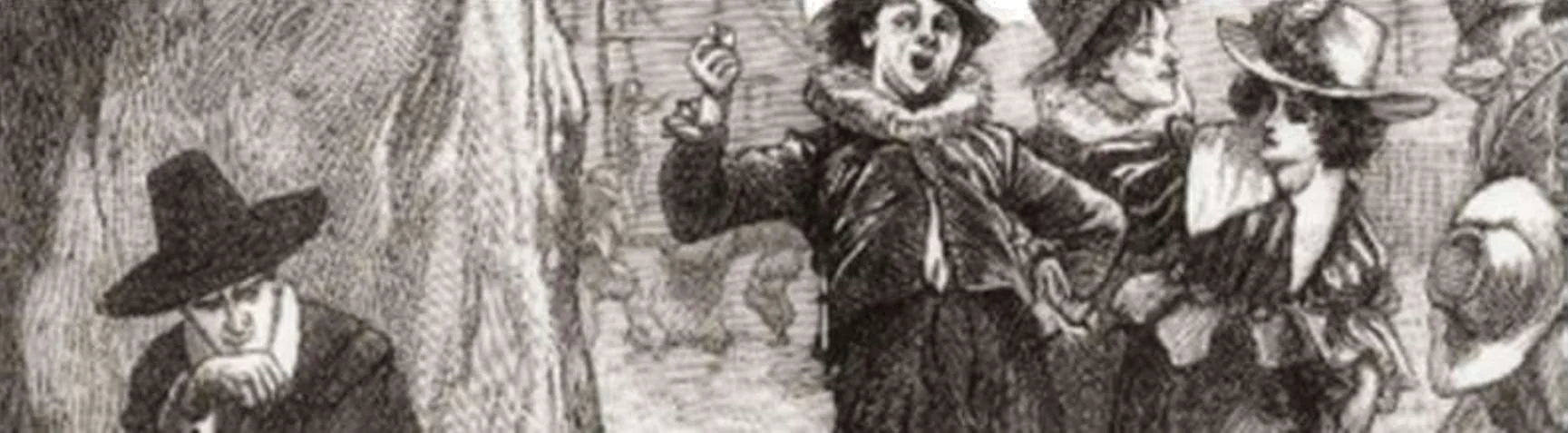
As a Baptist, Sampson never quite fit.
Sampson became a respected shoemaker, raised a family, and helped found Swansea. Yet because he was not part of the established Puritan church, he could not enjoy all the rights of a freeman, including voting and holding public office.
Then came a decision that has stayed with me. In 1669, Sampson applied to become a freeman but apparently declined to take the required oath. The oath conflicted with his beliefs, so Sampson accepted fewer political rights rather than compromise his conscience. I keep wondering whether I’d make the same choice.
John Thomas’s Move West
John Thomas Mason probably knew little about the religious struggles of his ancestor, Sampson. Yet nearly two centuries later, he faced a different kind of decision that also required courage.
Around 1840, John Thomas and his brother, David, left Savoy, Massachusetts, and headed west to northern Illinois. Like thousands of young Americans, they were drawn by stories of fertile prairie, inexpensive government land, and the chance to build something of their own. John Thomas wasn’t leaving because of religious persecution. He was leaving because he believed he could create a better future.
That took courage too. He left behind family, familiar landscapes, and the certainty of home for a place he had never seen. There were no guarantees that the gamble would succeed.
It did. In 1843, John Thomas purchased 140 acres of federal land for $1.25 an acre. Over the years he expanded his farm, and later generations transformed it into one of the well-known dairy farms in the Elgin area. His son, J.P., developed that dairy.
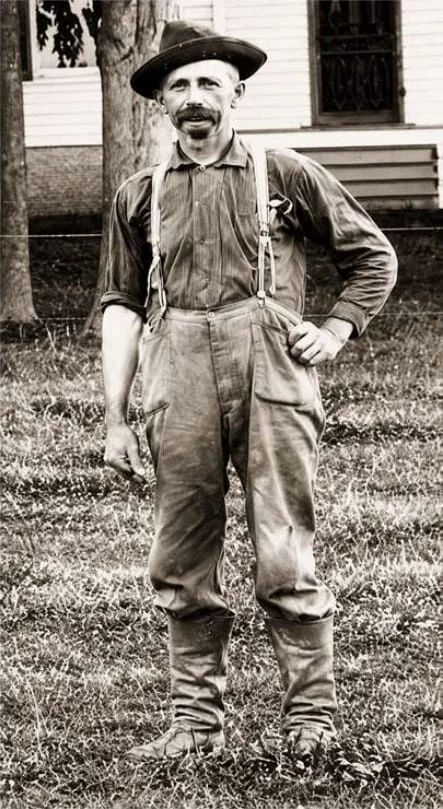
JP Mason
As I thought about these two men, I couldn’t help noticing the similarities. Sampson crossed an ocean in search of a place where he could live according to his convictions. John Thomas crossed a continent believing he could build a better future. Both left the familiar behind because they believed something worth pursuing lay beyond the horizon. Both men had incredible courage.
Research Puzzles: Unsolved
Some research puzzles stay with me longer than others. This one has stayed with me for forty years. How can a farm that shaped four generations simply disappear?
Have you been to Mason Road just off Randall Road in Elgin? That’s where David and John Thomas Mason bought land in 1843. That’s where J.P. operated a creamery and became well-known for his dairy farm. But what happened to J.P. Mason’s farm?
In 1929 the City Directory has Raymond Mason (J.P.’s son, my great-grandfather) renting from J.P. Mason. On the 1940 census, Raymond was working 65 hours per week on a rented farm. When I asked my father years ago what happened to the farm, he said that it was lost in the Depression. Was it just Raymond’s farm that was lost? Then a fire destroyed the farm, perhaps in the 1940s. I don’t know the date. I haven’t found any records of the sale of the land.
What happened to the farms that John Thomas and David purchased for $1.25 an acre in 1843? I’m still looking.
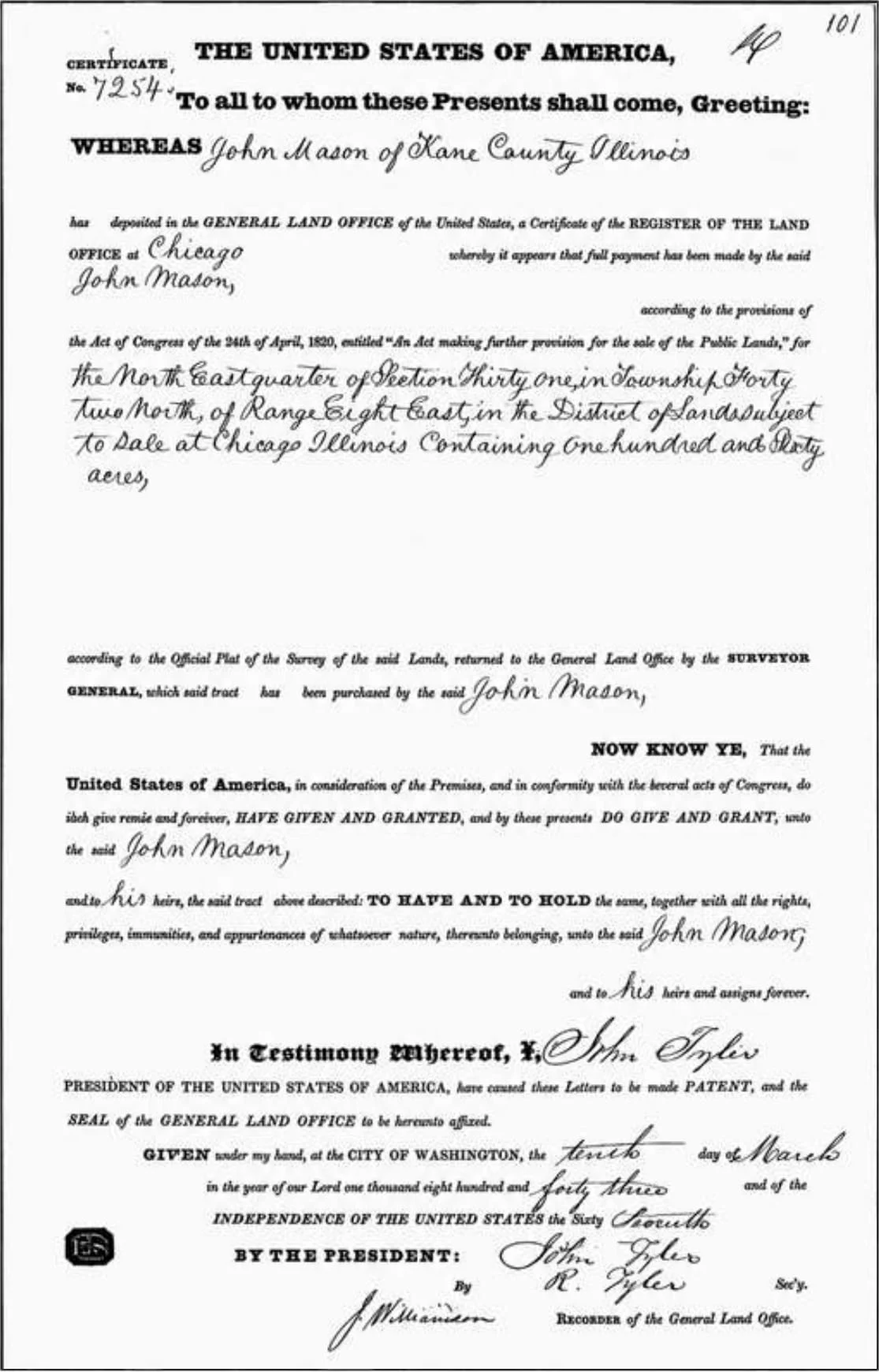
John’s Land Patent, 1843
AI in Genealogy
I developed a chart of the Place of Origin, Date Immigrated, and Place Settled of my ancestors. I wanted to understand whether there were patterns between the families. I asked ChatGPT to look for patterns I couldn’t easily see myself. I learned that the Mason line came mostly from East Anglia, in the later stages of the Great Migration. Other lines of my ancestors followed different patterns. This is exactly what I wanted to know, and AI helped me identify the patterns.
A Remarkable Discovery
One discovery surprised me while I was driving near my hometown. John Thomas’s farm stood on what is now Mason Road, just west of Elgin. In 1985, I drove there to see the land my ancestors had farmed. It was early autumn. Corn stood drying in the fields, and although the farmhouse was gone, a lonely silo and windmill still marked the place where generations of Masons had lived and worked.
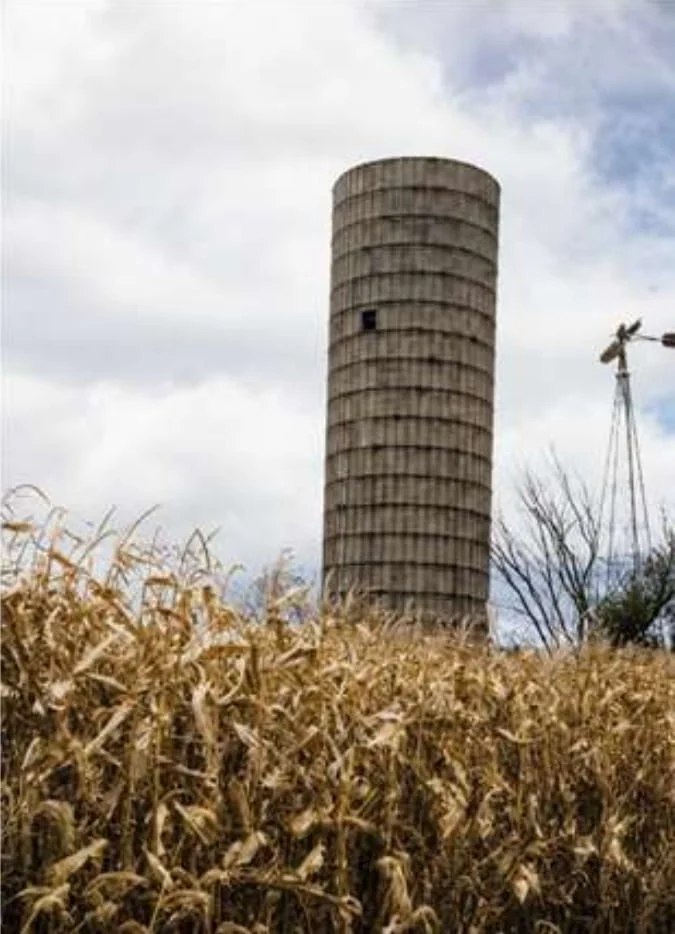
The silo and windmill that still marked the Mason land in 1985.
Forty years later, I returned with my brother. I wanted to photograph that old silo one more time. But nothing looked the same. The fields had disappeared beneath new development. Standing where John Thomas had once broken prairie sod was something he could never have imagined: a Tesla charging station.
John Thomas had come to Illinois believing in the future. Today, that same land is still looking towards the future—just in a way he never could have imagined.
A Closing Reflection
Working through the Mason records turned my thoughts to the strength of one’s beliefs—the price people accept for their convictions, and how such choices ripple across the generations that follow. Even now, I can’t be sure I would have chosen as Sampson did. Yet a month spent with his story has led me to examine my own life far more often.
Behind This Issue
Among the records used for this issue include The Genealogy of the Sampson Mason Family, Massachusetts town records, land records, and census documents. Additional documents can be found on my family tree on Ancestry.com.
What’s Next?
How did our immigrant ancestors learn about places in America to move? I explore this question as I research the lives of Martin and Annie (Olson) Jepson — read Issue #2.
Explore More on Ancestors2Illinois
Mason Family Blog Posts
- Our Mayflower Ancestor Wasn’t a Pilgrim
- The Ancestor Who Was Hanged for Murder
- The Man Who Sold Drinkable Gold (coming soon)
- The Brother of Martin Luther? (coming soon)
Subscribe to the Newsletter
Lives Behind the Records
Questions. Discoveries. Stories from Family History.