The Strange Naming Patterns of Sweden
October 2026 | Researching Family History | Jepson Family
By Susan Jepson Lenski
Connection: Jeppa Hansson was my 2nd great-grandfather.
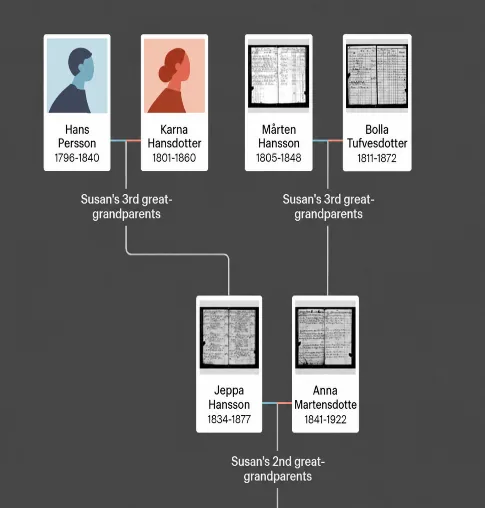
Family Tree showing how names changed.
A Jepson Relative?
Whenever I meet someone with the last name Jepson, I get a little excited.
Jepson isn’t a common surname in America, so my first thought is always: Maybe we’re related. Maybe this person is a distant cousin. Maybe we share the same Swedish ancestors.
But after years of genealogical research, I’ve learned something disappointing: They probably aren’t related to me at all.
That’s because Swedish surnames worked very differently from English or American ones for most of history. In fact, before the twentieth century, many Swedish families didn’t really have permanent last names at all.
And for genealogists, that creates both confusion and fascination.
The Swedish Naming Puzzle
In most family histories, surnames act like breadcrumbs through time. If you trace a name like Calkins, Wright, or Gerber far enough back, you’ll often discover common ancestors.
But Swedish names don’t work that way.
For centuries, Sweden used a patronymic naming system. Instead of passing down a fixed family surname, children received a last name based on their father’s first name.
If your father’s name was Anders, you became:
-
Andersson (“son of Anders”)
-
Andersdotter (“daughter of Anders”)
If your father’s name was Lars, the children became Larsson or Larsdotter.
And in my family’s case?
My immigrant ancestor Martin Jepson was originally Mårten Jeppsson — literally “Mårten, son of Jeppa.”
His father’s name was Jeppa Hansson.
And Jeppa’s father?
Hans, of course.
Once you see the pattern, Swedish records suddenly begin to make sense — but they also become much harder to follow.
Wait… Everyone’s Last Name Changed?
Yes.
Every generation created a new surname.
That means family names constantly shifted:
-
Hans’s son became Hansson
-
Jeppa’s son became Jeppsson
-
Mårten’s son would have become Mårtensson
Imagine trying to trace your ancestors when the family surname changes every single generation.
Even more confusing, daughters had entirely different endings. Martin’s sister Johanna was not “Jepson” at all — she was Jepsdotter.
For modern researchers, it can feel like trying to solve a puzzle where all the pieces keep changing shape.
Sweden Slowly Changed the Rules
These naming customs began fading in the late 1800s as Sweden modernized.
Some families started keeping fixed surnames earlier than others. My ancestor Martin adopted the permanent surname Jepson after immigrating to America. But his wife’s family had already started using fixed surnames in Sweden.
She was named Anna Olsson — and interestingly, her father was also Olsson. Their family had already abandoned the older patronymic pattern.
Eventually Sweden formalized the change through the Names Adoption Act, with reforms beginning in 1901 and becoming fully standardized in 1963.
By then, permanent surnames had become the norm.
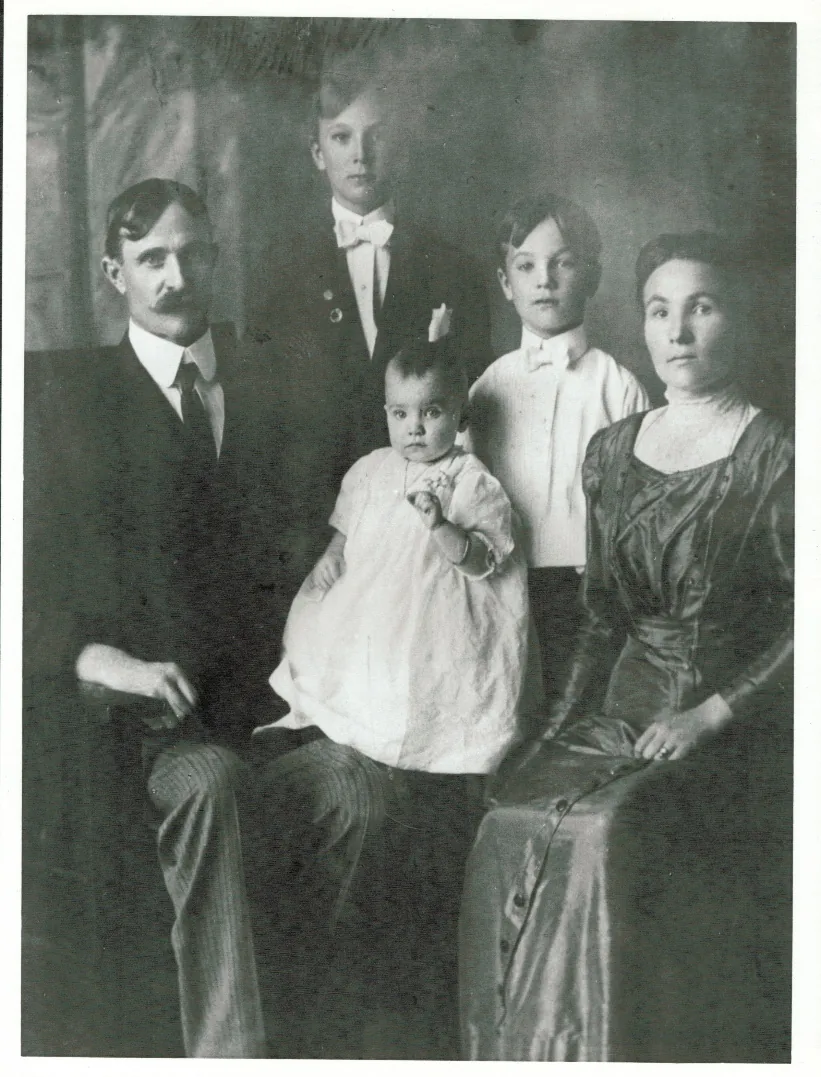
Jepson family in 1913. Everyone shared the last name Jepson.
So How Do You Find Swedish Ancestors?
At first glance, Swedish genealogy sounds impossible. If surnames constantly changed, how can you trace anyone backward?
Fortunately, Sweden created some of the best historical records in Europe.
Beginning in the 1600s, Swedish Lutheran priests kept detailed parish records called Household Clerical Surveys (husförhörslängder). These records functioned almost like annual censuses. Priests recorded:
-
births
-
deaths
-
marriages
-
moves between villages
-
occupations
-
literacy
-
religious knowledge
For genealogists, these records are gold.
But you still need a starting point.
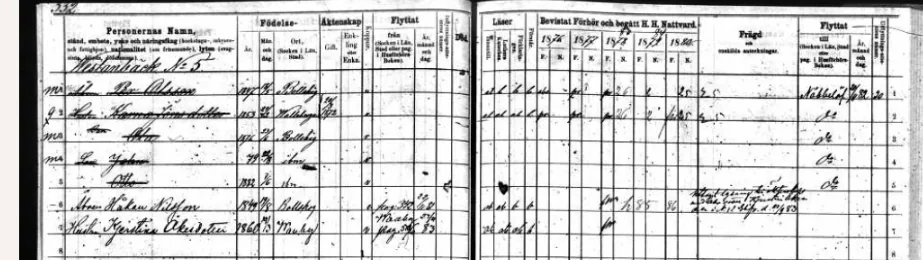
Household Clerical Survey for Olsson family, 1885.
The Clue That Broke Open Our Family Mystery
In our family’s case, the breakthrough came from Martin Jepson’s death certificate in Chicago.
It listed only one useful clue:
“Skona, Sweden”
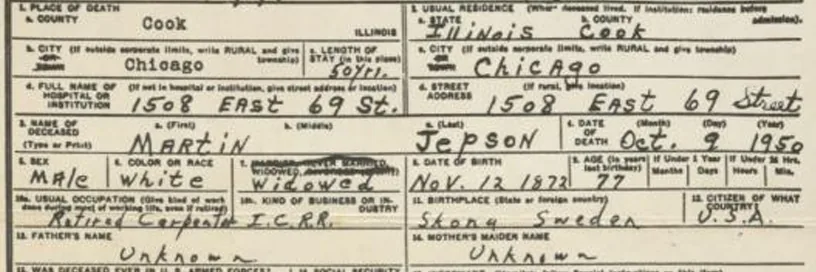
Martin Jepson’s death certificate, 1950.
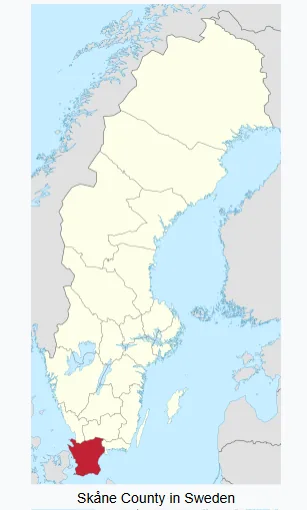
At first glance, that didn’t mean much. But “Skona” was almost certainly the Americanized pronunciation of Skåne, the southernmost county in Sweden.
Combined with census records showing that Martin immigrated in 1893, we finally had enough information to begin searching Swedish archives.
We contacted the archives in Malmö, the major city in Skåne.
That search led to emigrant records.
The emigrant records led to Bolshög Parish.
And Bolshög Parish led us to Martin’s parents — and eventually four generations beyond them.
The Part that Stays with Me
Researching Swedish ancestors can feel frustrating compared to tracing families with stable surnames.
You can’t simply follow a name backward through time. You have to piece together locations, birthdates, parish records, migrations, and family relationships.
But that challenge is also what makes Swedish genealogy so rewarding.
Every discovery feels earned.
And every ancestor recovered from those old parish books reconnects a small piece of a family story that might otherwise have disappeared.
Sources and Related Reading
This article is based on:
- Your Swedish Roots: A Step by Step Handbook by Per Clemensson and Kjell Andersson, 2004.
- The Family Tree Scandinavian Genealogy Guide: How to Trace Your Ancestors in Denmark, Sweden, and Norway by David A. Fryxell, 2019.
Explore More on Ancestors2Illinois.com
Subscribe to the Newsletter
Lives Behind the Records
Questions. Discoveries. Stories from Family History.
Contact: info@ancestors2illinois.com