October 2026 | From Research to Book | Hardy Family
By Susan Jepson Lenski
Connection: Sidney Hardy was my 2nd great-grandfather.
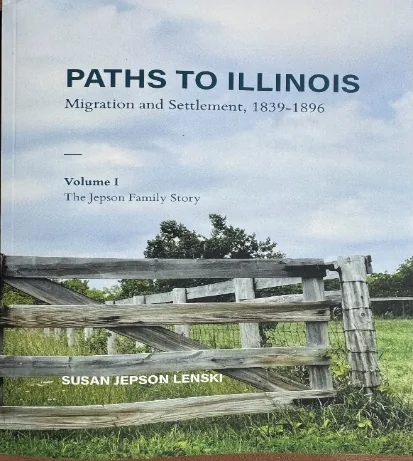
Family History Book, Vol. I, 2026.
Finding a Voice for Writing Family History
I started writing the first paragraph of my family history book twenty-eight times.
I had eight years of research. I knew the families. I knew the history. I knew what I wanted the book to accomplish. And I had an audience I cared about very much: my family.
But every time I started writing, the sentences sounded stiff, formal, and—there is no easy way to say it—boring.
The problem wasn’t that I didn’t have anything to say. I just didn’t know how to say it in a way my family would want to read.
I Knew How to Write—Just Not for Family
I had spent much of my professional life as a university professor. I was accustomed to academic writing: research reports, professional books, articles, and interpretations of research.
When I began studying genealogy, I wrote research reports for my coursework. Once again, the emphasis was on evidence, documentation, and precision. I could document where an ancestor lived in 1850. I could explain conflicting census records. I could cite the land transaction that showed when a family arrived in Illinois.
That training served me well as a family historian. It did not necessarily serve me well as a storyteller.
Thinking About the Reader
Eventually, I realized that I needed to stop thinking primarily about the information I wanted to include and start thinking about my readers.
I pictured my thirty-year-old nephew. He has a busy life. He isn’t particularly interested in genealogy. He certainly isn’t waiting eagerly for a detailed report about one of his nineteenth-century ancestors.
But perhaps he might read a good story. That became my test. Could I write something he would actually want to keep reading?
I was still struggling to do that when a friend suggested that I try AI.
My First Experiment with AI
I resisted the idea for a couple of months. Eventually, after watching several presentations about using AI in genealogy, I decided to try it.
I already had a carefully researched biographical sketch of one of my ancestors, complete with footnotes. Rather than asking AI to research my ancestor, I gave it my own research and asked it to help me change how it was written.
Here is a section of that piece of writing:
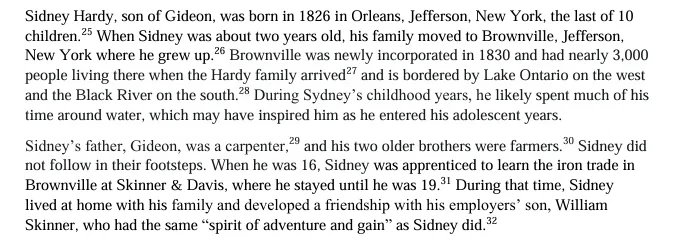
You can see why that kind of writing would not be interesting to my nephew!
So, I gave AI a prompt.
Rewrite this sketch so that my 30-year-old nephew, who is not very interested in family history and has a busy life, would find this sketch intriguing. Keep all of the evidence that is footnoted but delete the footnotes. Write in an informal, friendly tone with a variety of paragraph lengths and sentence styles.
The result surprised me. It was lively. It was informal. And it was much more interesting than what I had been writing.
There was only one problem: It didn’t sound like me.
The First Draft Wasn’t the Answer
Some of the language of that first draft was too casual. Some phrases sounded like something generated by AI rather than something I would ever say.
But that first response taught me something important. My research could be transformed into writing that would be interesting to a family member. I just needed to find a balance between my research report and the AI-generated draft.
So instead of abandoning the experiment, I gave AI another instruction:
Revise this piece so that it is more restrained and written for a mature reader. Write in narrative form but make it somewhat more formal. Avoid language and phrases that sound AI-generated. Use a variety of sentence lengths and types.
The second version came much closer. It had a narrative structure that worked, but the language still didn’t sound like what I would have written. But I had a start.
Suddenly I wasn’t staring at a blank page anymore; I had a draft.
The Most Important Step: Editing It Myself
Now I had to revise the writing so that it sounded more like the new me: the family history researcher who was telling a story. I changed words. I deleted phrases. I rewrote sentences. I added things that mattered to me and removed things that didn’t.
Most importantly, I put my own words back into the story.
AI didn’t write my family story, but it helped me get past the barrier that was preventing me from writing it.
That distinction became important in the way I use AI.
Using One Good Piece as a Model
Once I had a biographical sketch that sounded right, I had something I had never had before: A model of my own family-history voice. I began using that piece as a template.
As I wrote additional sections, I used that first piece to tell my story. I usually was able to come pretty close to the narrative voice I wanted, but I also had sections that were too scholarly. When that happened, I uploaded my draft into the AI program and asked it to revise to match the tone of my template.
I always needed to edit the piece, but I had an excellent working draft.
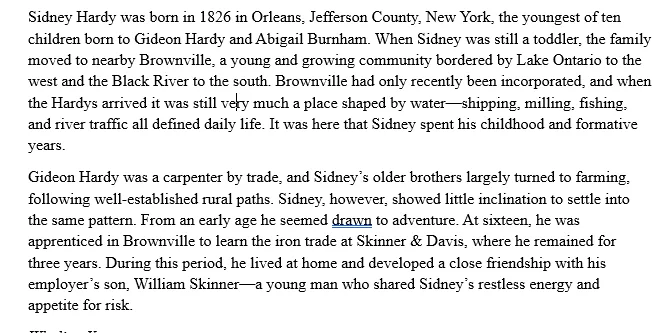
Here is the template I used for future pieces. As you can see, the final version was still expository writing, just softened with a narrative voice.
Later, I wrote a biography of Sidney Hardy, and I wanted the text to be even more informal. I entered this text:
Sidney Hardy was born in 1826, the youngest of ten children. His father was a skilled mechanic who worked in Brownsville. Sidney had twin sisters who were three years older than he was. He grew up with his sisters, probably helping them with household chores. He grew up smothered by love, but as he grew older, he wanted to break away and become his own man.
I knew that I was listing facts rather than telling a story. I asked AI to help me move to a more narrative voice through a prompt asking it to help me “tell a story” rather than “list a series of facts.” After several tries and numerous edits, I ended with this version.
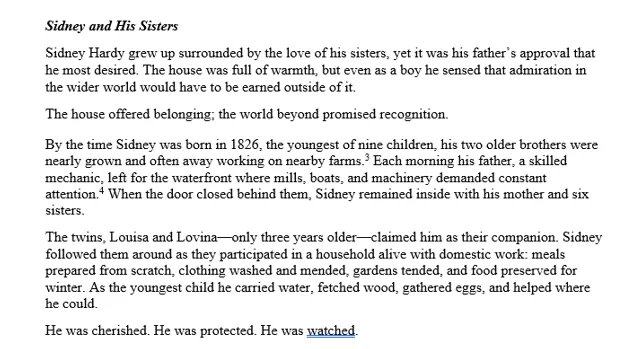
As you can see, the facts are there, but the story is more compelling. This version worked well for the biography I was writing, and I used it for a model as I continued to write.
I Learned to Ask for Specific Changes
As I experimented with my model chapter, I found another stumbling block. I couldn’t come up with good transitions between some of the paragraphs. I decided to ask AI for help.
Another of the biographical sketches that I had written was much too long. I began revising it to make it shorter, but I wondered what AI would do.
So, I asked AI to shorten the piece by 20 percent without losing important information.
Those experiments worked remarkably well and taught me another lesson: AI can help with very specific writing problems.
Here are some ideas I’ve tried:
-
Make this less formal.
-
Shorten this without losing evidence.
-
Improve the transition between these sections.
-
Identify places where I repeat myself. (This happened often!)
-
Revise the subheadings.
Those are often the kinds of tasks for which I now find using AI can help me when I get stuck.
AI as Research Assistant and Editor
When I wrote for academic publishers, I often had a research assistant and a copy editor for my books. The research assistants were people knowledgeable in the field and responded to the drafts of my manuscripts with ideas and corrections. I used AI for this purpose.
For example, for one of my books, I wrote life scenarios that took place in 1850. After I wrote a scenario, I asked AI for to point out historical errors. Sure enough, it found some. In one scenario I wrote about the family making jam and putting it up in Mason jars. AI told me that Mason jars hadn’t been used at that time and place. Since AI can make mistakes, I researched Mason jars on Google and found that AI was correct: I had made an historical error.
In addition, when I was an academic, I always had a copyeditor. Always. This was a person who read every word, looking for and finding errors in wording, usage, and punctuation. They also smoothed out transitions and revised awkward sentences.
Now I use AI for this purpose. After writing, I upload the section into AI and ask it to copyedit the text without changing any ideas and leaving most of the wording as it is. Sometimes I change the punctuation AI proposes. (I was an English teacher before becoming a professor.) Overall, though, I have been pleased with the accuracy of AI’s copyediting, and it saves me hours of time.
What You Can Try
If you have finished years of family research but don’t know how to turn it into something your relatives will read, don’t begin by asking AI to “write my family history.”
Start smaller.
Choose one short, well-researched piece you have already written. Then decide who you want to read it.
A grandchild?
A cousin who knows almost nothing about the family?
Other genealogists?
Members of a local historical society?
Tell AI who that reader is and what kind of experience you want that person to have. Ask it to preserve your facts while experimenting with voice, structure, or pacing.
Then read the result critically.
Keep what works.
Change what doesn’t.
And once you have a piece that genuinely sounds like you, save it. That piece can become the model for the writing that follows.
The Part That Stays With Me
AI did not solve my writer’s block by giving me better facts. For years, I had approached family history as a researcher. I had concentrated on accuracy, evidence, and documentation—and I still do.
But research isn’t finished simply because we have discovered what happened.
These are stories that deserve to be told, and AI helped me tell my stories.
For me, AI became a bridge between those two parts of family history: researching the past and writing about the past so that people can read it.
I still decide what the story means. I still determine which evidence belongs. I still write the first few drafts. I still revise the sentences, edit the piece, and make the final decisions.
But I no longer start the first paragraph twenty-eight times.
And, most importantly, my family now reads what I write. *
*It’s my understanding that using AI this way would be considered AI-assisted writing.
Sources and Additional Resources
- National Genealogy Society: GenTech Toolbox
- Hands-On AI for Family History Writing
- Paths to Illinois: Migration and Settlement, 1834-1880, Vol. II The Davis Family Story
- For Something or Nothing: A Life of Striving in the Age of Whaling, the Gold Rush, and Westward Expansion
- ChatGPT
From Research to Book Blog Posts
(Coming Soon)
- Turning Records into Stories
- Where Do I Begin?
- Choosing a Title for Your Book
Ancestors2Illinois.com
Subscribe to the Newsletter
Lives Behind the Records
Questions. Discoveries. Stories from Family History.
Contact: info@ancestors2illinois.com