
Johann Friedrich Christian Stolt (1830-1880)
Hohenwarth, Pomerania (Pommern), Prussia → Elgin, Kane County, Illinois
Young farmhand in Prussia who came to Illinois for economic opportunities.
Quick Facts
- Born: 21 December 1830, Hohenwarth, Grimmen, Pomerania, Prussia
- Died: 14 November 1880, Elgin, Kane County, Illinois
- Spouse: Augusta Weber
- Occupation: Store Owner
- Illinois Settlement: Elgin, Kane County
Connection to Author: 2nd great-grandfather (Davis line)
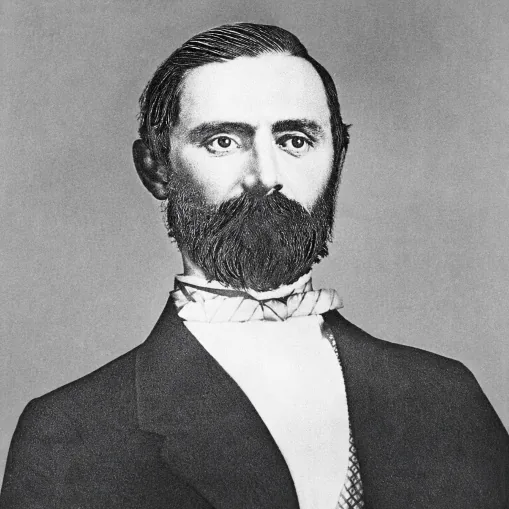
Fred Stolt, date unknown.
Early Life
Johann Friedrich Christian “Fred” Stolt was born on 21 December 1830 in Hohenwarth, a tiny farming village near Grimmen in the Prussian province of Pomerania. His father, Johann Christian Stolt, was a tenant farmer, and the Stolt family had deep roots in the region.As the fourth son in a farming family, Fred had little prospect of inheriting the family’s land tenancy. His childhood would have centered on farm labor, with limited opportunity for education. Hohenwarth had no school of its own, and later American census records reported that Fred could neither read nor write.As Fred approached adulthood, his prospects in Pomerania were limited. Agricultural difficulties had increased rural poverty, and as a young Prussian man he also faced compulsory military service.
Why He Left
Fred reached adulthood at a difficult time in Pomerania. Poor harvests, falling grain prices, rural debt, and limited access to land left few opportunities for a younger son of a tenant farmer. He also faced conscription into the Prussian military. Young men were generally required to enter active military service and remained subject to reserve and militia obligations for years afterward.No letter or other personal account survives explaining Fred’s decision, so we cannot know precisely what motivated him. But limited economic prospects and the prospect of military service provided powerful reasons for a young man in his circumstances to consider leaving.By the early 1850s, large numbers of German immigrants had already established communities in the American Midwest. Around 1854, Fred joined them.
Journey to Illinois
No passenger list has been located for Fred, and it is not known whether he emigrated alone or traveled with relatives or acquaintances. His death certificate places his immigration around 1854, while his obituary indicates that he reached the Elgin area around 1857.His exact route is also unknown. Like many German immigrants traveling to the Midwest during this period, he may have sailed from a German port to New York and then traveled west using the rapidly developing network of canals, railroads, lake steamers, and trains.Whatever route he followed, Fred eventually reached northern Illinois and settled among the growing German-speaking population around Elgin.
Building a Life in Illinois
The first clear record of Fred in America places him in Clintonville, now South Elgin, where he was working as a butcher in partnership with C. Kerber by 1859. Butchering made practical use of skills Fred would have learned growing up on a farm—handling livestock, slaughtering animals, and understanding meat production. But Fred did not remain a butcher. Over the following years, he repeatedly expanded his business interests.In 1866, Fred married Augusta Weber, whose German immigrant family had established a successful farm in Hanover Township. By 1867, Fred was operating a dry-goods and grocery business in Elgin.The 1870 census shows how quickly he had progressed. Fred owned $1,000 in real estate and had a personal estate valued at $1,600. Remarkably, the same census reported that he could neither read nor write. Whatever Fred lacked in formal schooling, he apparently compensated for with practical intelligence, memory, mental arithmetic, business judgment, and the assistance of people around him.His business continued to expand. In 1875, Fred and John Gieske constructed a 3,200-square-foot commercial building at 20 Douglas Avenue. Fred moved his grocery business there, while Augusta established a millinery shop. Over time, the Stolts acquired additional property around the building.Economic conditions changed after the Panic of 1873, and in 1878 Fred liquidated his dry-goods business. Rather than simply continue with an increasingly difficult enterprise, the family concentrated more heavily on Augusta’s successful millinery business while earning income from their property.Fred also became involved in local civic and political life. He participated first in Greenback Party activities and later in Democratic Party caucuses, and he belonged to Elgin’s Merchants’ Singing Club.By 1880, Fred and Augusta were raising six children and appeared well established in Elgin. Then their lives changed abruptly. Fred suffered a stroke and died on 14 November 1880. He was only forty-nine years old.He was buried at Bluff City Cemetery in Elgin.
Migration Timeline
This timeline shows the migration path to Illinois of Fred Stolt.
| Name | Date | From | To |
|---|---|---|---|
| Johann Friedrich Christian Stolt (1830-1880) | Pomerania, Prussia, German Confederation | About 1854 (According to death certificate) |
Elgin, Kane, Illinois |
Why This Story Matters
Fred Stolt’s story challenges some of our assumptions about what immigrants needed in order to succeed in nineteenth-century America. He did not arrive with wealth or extensive schooling. He came from a tenant-farming family in a tiny Pomeranian village and was the fourth son, with little prospect of inheriting the family’s land tenancy. Even years after reaching Illinois, the census reported that he could neither read nor write.Yet Fred became a successful businessman.The skills that mattered were not necessarily the ones recorded on a school certificate. His farm upbringing had taught him how to handle livestock and work physically, skills he could immediately use as a butcher. From there, he moved into groceries and dry goods, invested in commercial property, and adjusted his business strategy when economic conditions changed.His inability to read or write makes his later involvement in business, politics, and community organizations particularly revealing. Fred was clearly capable of understanding the economic world around him, developing relationships, making financial decisions, and recognizing opportunities. Literacy and intelligence were not the same thing.His story also illustrates an important feature of immigration: people did not necessarily continue doing in America exactly what they had done in Europe. Fred brought agricultural skills from Pomerania, but America gave him access to a growing city where those skills became the starting point for something very different.By the time of his death, the tenant farmer’s son had become a merchant and property owner in one of northern Illinois’s growing industrial cities.Fred’s life reminds us that the resources immigrants carried with them were not always visible on a passenger list. Practical knowledge, adaptability, ambition, memory, judgment, and the ability to build relationships could be forms of capital too.
Source Documents
The research documents for the Stolt 1854 migration story:
- Biographical Sketch (PDF)
- Migration to Illinois (PDF)
- Genealogical Summary and Children (PDF)
- Legacy (PDF)
Related Reading
- Stolt, Augusta (Weber)
- Stolt Migration Story
- Paths to Illinois, Volume II The Davis Family Story
- Migration Timeline of all sixteen families
- Ancestors & Surnames index
My Blog and Newsletter have additional stories and research related to the Stolt family.