
Augusta Weber Stolt (1846-1936)
Darmstadt, Hesse, Germany → Hanover Twp., Cook County, Illinois
Young girl who migrated with family so that her father could do extensive farming in Illinois.
Quick Facts
- Born: 19 October 1846, Darmstadt, Hesse, Germany
- Died: 23 May 1936, Elgin, Kane County, Illinois
- Spouses: Fred Stolt, William Wahl
- Occupation: Milliner
- Illinois Settlement: Hanover Twp., Cook County and Elgin, Kane County
Connection to Author: 2nd great-grandmother (Davis line)
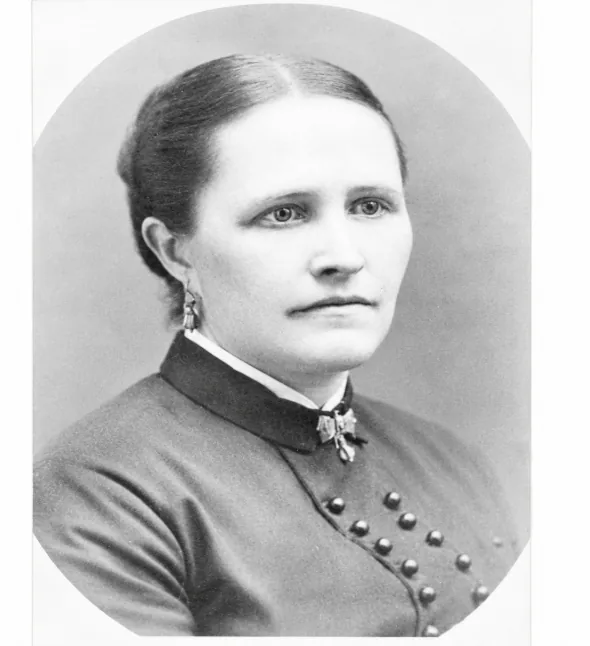
Augusta Weber, date unknown.
Early Life
Augusta Weber was born on 19 October 1846 in Darmstadt, Hesse, the daughter of Ferdinand Weber and Engel Pfingsten. She was not yet two years old when her parents decided to leave Germany for America.
In 1848, Augusta crossed the Atlantic with her parents and three older sisters aboard the Monterey. The family eventually settled in Hanover Township near present-day Bartlett, where Ferdinand hoped to engage in the “extensive farming” that had been difficult to achieve in Germany.
Augusta remembered little, if anything, of Germany. Her childhood was an Illinois immigrant childhood, spent helping her family transform prairie into a prosperous farm. Because Ferdinand and Engel had seven daughters and no sons, the girls contributed directly to the agricultural work as well as household responsibilities.
The experience gave Augusta a practical education in work, responsibility, and family cooperation that would become increasingly important later in her life.
Why She Left
Unlike many of the people highlighted on Ancestors2Illinois, Augusta did not make the decision to migrate. She was a toddler when Ferdinand and Engel took their four daughters to America.
Her migration story therefore illustrates another aspect of immigration: children could have their lives completely redirected by decisions made by their parents.
Ferdinand’s decision meant that Augusta grew up not in the constrained agricultural world around Darmstadt, but on the developing Illinois prairie. The opportunities available to her as an adult—including the ability to operate her own business in a growing American city—would be very different from those her parents had left behind.
Journey to Illinois
Augusta traveled with her parents and sisters from Bremen aboard the Monterey, arriving in New York on 27 September 1848.
The passenger list indicates that the family’s intended destination was Ohio, but they ultimately continued west and settled in Hanover Township, Cook County, Illinois.
The family’s first home was a primitive log cabin with a loft where the children slept. Family recollections tell of winter storms during which snow blew through the roof and landed on their blankets.
From those difficult beginnings, the Weber family gradually established one of the more prosperous farms in their community.
Building a Life in Illinois
On 1 April 1866, nineteen-year-old Augusta married Fred Stolt. Fred had emigrated from Pomerania and established himself as a butcher before moving into selling groceries and dry goods in Elgin.
Augusta’s life soon moved away from the farm environment in which she had been raised. She and Fred became part of Elgin’s growing German-American business community, and Augusta established a millinery shop specializing in women’s hats.
By the mid-1870s, Fred and Augusta were operating their businesses from a substantial commercial building at 20 Douglas Avenue. The grocery occupied part of the building, while Augusta ran her millinery business. The family lived upstairs.
Then, in November 1880, Fred suffered a stroke and died. Augusta was only thirty-four years old and had six children ranging from infancy to adolescence.
Augusta became executor of Fred’s estate and assumed responsibility for settling his debts. She obtained permission to sell the family’s commercial property, continued operating her millinery business, and advertised her services in Elgin’s German-language newspaper.
In November 1882, Augusta married William Wahl, a family friend. She and her six Stolt children joined William’s household, and Augusta and William subsequently had three children together.
Economic security remained elusive. After Augusta inherited money from her parents, she and William eventually moved their family to Noble in southern Illinois and attempted farming. The venture coincided with the severe economic conditions surrounding the Panic of 1893 and ultimately failed. The family returned to Elgin having lost their savings.
Augusta rebuilt again.
By 1910, she and William were living in Hanover Township, the same area where Augusta had grown up. The census listed Augusta as head of household, an unusual and revealing designation for a married woman of her generation.
William died in 1916. Augusta lived another twenty years, eventually returning to Elgin. She died of pneumonia on 23 May 1936 at the age of eighty-nine and was buried beside Fred Stolt at Bluff City Cemetery.
Migration Timeline
This timeline shows the migration path to Illinois of Augusta Weber.
| Name | Date | From | To |
|---|---|---|---|
| Ferdinand Weber, Engel Pfingsten, Augusta Weber | Darmstadt, Hesse, Germany Confederation | 1848 | Hanover twp., Cook, Illinois |
Why This Story Matters
Augusta’s life reminds us that women’s economic contributions did not begin in the twentieth century. Long before women had equal legal or professional opportunities, some women were already running businesses, managing estates, making financial decisions, and holding families together through profound economic change.
What distinguishes Augusta is not that she avoided failure or loss. It is that neither permanently took away her ability to act. That distinction makes her story important. Resilience can sound passive when we describe someone as having “endured” difficult circumstances. Augusta’s resilience was active. She ran a business, administered property, managed family resources, moved when circumstances required it, and rebuilt after financial setbacks.
Augusta’s story is not simply one of endurance. The records allow us to see something more: again and again, she acted.
Source Documents
The research documents for the Weber 1848 migration story:
- Biographical Sketch (PDF)
- Migration to Illinois (PDF)
- Genealogical Summary and Children (PDF)
- Legacy (PDF)
Related Reading
- Stolt, Johann Friedrich Christian
- Weber Migration Story
- Paths to Illinois, Volume II The Davis Family Story
- Migration Timeline of all sixteen families
- Ancestors & Surnames index
My Blog and Newsletter have additional stories and research related to the Stolt family.