
Solomon Wright, Jr. (1780-Aft. 1858)
Carmel, Putnam, New York→ Burlington, Kane County, Illinois
Fifty-six year old farmer who left New York for inexpensive land on the Illinois frontier.
Quick Facts
- Born: 08 February 1780, Carmel, Putnam, New York
- Died: After 1858, Burlington, Kane County, Illinois
- Spouse: Zilpha Baldwin
- Occupation: Farmer
- Illinois Settlement: Burlington, Kane County
Connection to Author: 4th great-grandfather (Davis line)
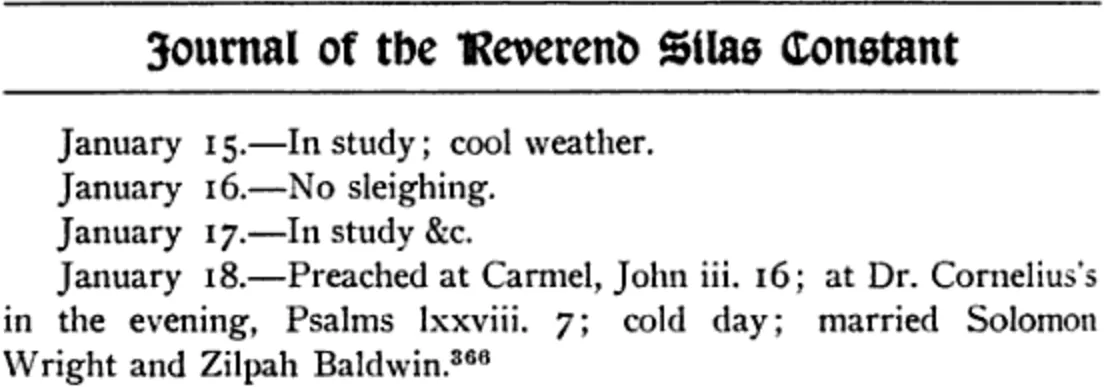
Marriage between Solomon and Zilpah in 1801, recorded in the Journal of the Reverend Silas Constant.
Early Life
Solomon Wright, Jr. was born on 8 February 1780 near Carmel, then in Dutchess County, New York. He was the only known surviving child of Solomon Wright, Sr. and Mary Hawxhurst, a Quaker family.By the time Solomon was born, his parents had moved inland from Long Island to the Carmel area. He therefore grew up in a family for whom migration in search of land and opportunity was already a familiar pattern.On 18 January 1801, Solomon married Zilpha Baldwin of nearby Mahopac. She, too, descended from a long-established Quaker family. Together they had eight children between 1802 and 1822.
Why He Left
For more than thirty years, Solomon and Zilpha built a stable life in New York. During the 1820s, Solomon bought and sold substantial tracts of land and eventually held more than 180 acres. He was not a young man unable to establish himself, nor was he being forced west by failure.Then his circumstances changed.In 1835, his daughter, Emeline, and her husband, Alson Banker, left New York and settled in Burlington, Kane County, Illinois. Their move gave the Wright family a direct connection to the opportunities becoming available on the Illinois prairie.On 30 April 1836, Zilpha died after thirty-five years of marriage.Later that year, fifty-six-year-old Solomon decided to leave New York. Two of his younger sons, Elisha and fourteen-year-old Daniel Cornell Wright, went with him. His older children with established lives did not.We cannot know exactly how Zilpha’s death affected Solomon’s decision. But its timing is striking. After decades of stability, the structure of his household had changed profoundly just as Illinois offered opportunities for the sons who were still at home.Solomon chose to begin again.
Journey to Illinois
Solomon and his sons left Carmel in 1836 and traveled west toward Illinois.Their journey followed the established transportation corridor connecting New York with the developing Midwest. From the Carmel area, they traveled toward the Hudson River and Albany, then west along the Erie Canal to Buffalo. From there, Great Lakes transportation carried travelers toward Chicago, followed by an overland journey across the prairie into Kane County. Their destination was Burlington, where Solomon’s daughter, Emeline, and her family had already settled.This family connection mattered. Solomon was moving into a new region, but he was not arriving without a network. One of his children was already there, and two sons traveled with him.
Building a Life in Illinois
Solomon did more than relocate. He established himself again as a substantial landholder.Between 1843 and 1844, he obtained multiple federal land patents totaling more than 250 acres in Kane County. He and his sons developed productive farms during a period when northern Illinois agriculture was expanding rapidly.Other members of the family followed. Solomon’s son, Ebenezer Baldwin Wright, and his family came to Kane County in the early 1840s and eventually settled in Plato. Three of Solomon and Zilpha’s children’s family lines ultimately became established in Illinois: Emeline, Ebenezer, and Daniel Cornell.Not every migration became permanent. Solomon’s son Elisha eventually returned east with his wife, Catherine, demonstrating that family connections continued to pull in both directions.By the 1850s, Solomon, Ebenezer, and Daniel Cornell were successful Illinois farmers. The move Solomon had made after Zilpha’s death had helped establish another branch of the Wright family in northern Illinois.Solomon died in Burlington in 1858. He died intestate, and his land and personal property were distributed among his children. His burial place has not been conclusively identified.
Migration Timeline
This timeline shows the migration path to Illinois of Solomon Wright’s ancestors.
| Name | Date | From | To |
|---|---|---|---|
| Peter Wright (1595-1675) (with brothers Anthony and Nicholas) |
Aug 1635 | Wendling, Norfolk, England | Saugus (now Lynn), Massachusetts |
| 1637 | Saugus (now Lynn), Massachusetts | Sandwich, Plymouth, Massachusetts | |
| 1663 | Sandwich, Plymouth, Massachusetts | Oyster Bay, Long Island, New York | |
| Solomon Wright, Sr. (1742-1823) | Before 1780 | Oyster Bay, Nassau, New York | Carmel, Dutchess (now Putnam), New York |
| Solomon Wright, Jr.(1780-1858) | 1836 | Carmel, Putnam, New York | Burlington, Kane, Illinois |
Why This Story Matters
Solomon Wright’s migration challenges the familiar image of the westward pioneer as a young man with little to lose. Solomon had a great deal to leave behind. At fifty-six, he had spent more than three decades building a life in New York. He had raised a large family with Zilpha, accumulated substantial land, and reached an age when remaining where he was would have been the easier choice.Solomon’s story is, therefore, not primarily about a restless search for something better. For decades, he had lived a good life in New York. After his circumstances changed, he decided it was time to move. His life reminds us that starting over is not confined to youth. At fifty-six, after loss had changed the life he knew, Solomon Wright still had the capacity to imagine—and build—another one.
Source Documents
The research documents for the Wright 1836 migration story:
- Biographical Sketch (PDF)
- Migration to Illinois (PDF)
- Genealogical Summary and Children (PDF)
- Legacy (PDF)
Related Reading
- Wright, Zilpha (Baldwin)
- Wright Migration Story
- Paths to Illinois, Volume II The Davis Family Story
- Migration Timeline of all sixteen families
- Ancestors & Surnames index
My Blog and Newsletter have additional stories and research related to the Wright family.