
Engel Pfingsten Weber (1814-1883)
Darmstadt, Hesse, Germany → Hanover Twp., Cook County, Illinois
Wife who left Germany with her family to do extensive farming on the Illinois frontier.
Quick Facts
- Born: 16 June 1814, Darmstadt, Hesse, Germany
- Died: 21 December 1883, Bartlett, Cook County, Illinois
- Spouse: Ferdinand Weber
- Occupation: Homemaker
- Illinois Settlement: Hanover Twp., Cook County
Connection to Author: 4th great-grandmother (Davis line)
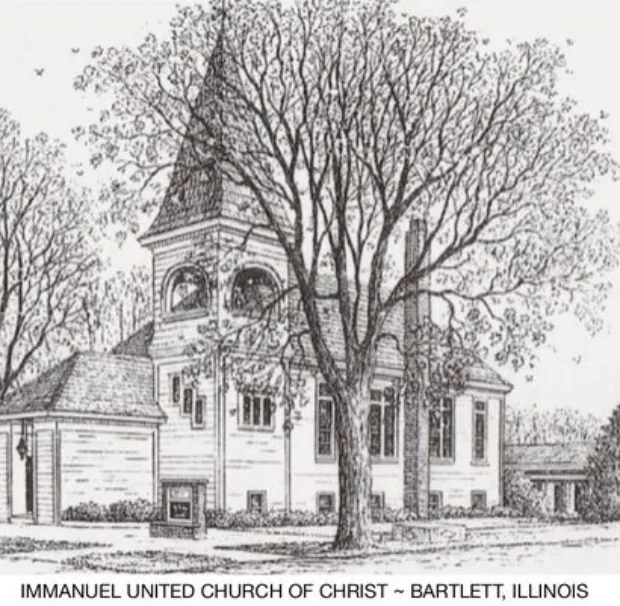
Church founded in Bartlett in 1891 for German-speaking residents.
Early Life
Engel Pfingsten was born in 1814 in Darmstadt, in the Grand Duchy of Hesse. Little has been discovered about her parents or childhood. She grew up in a region where rural life was shaped by small-scale agriculture, established communities, and strong local and family ties.Engel married Ferdinand Weber around 1838, probably in Darmstadt or a nearby community. During the next eight years, she gave birth to four daughters—Caroline, Sophia, Julia, and Augusta. By the time the family began considering emigration, Engel was a mother responsible for four young children.
Why She Left
Ferdinand later told his daughters that he had come to America hoping to engage in “extensive farming.” In Hesse, population growth and limited farmland made it difficult for a farmer to acquire enough land to expand and prosper.In 1848, Ferdinand and Engel decided to take their family to America. We do not know how Engel felt about leaving Germany or what role she played in the decision. The surviving records tell us Ferdinand’s ambition, but they do not preserve Engel’s thoughts. For Engel, however, migration meant leaving behind the familiar world in which she had spent the first thirty-four years of her life and undertaking an uncertain journey with four young daughters.
Journey to Illinois
Engel and Ferdinand left Bremen with their daughters aboard the
Monterey
. After a transatlantic voyage by sailing ship, the family arrived in New York on 27 September 1848.Traveling with four young children would have added considerably to the difficulties of the crossing. Space aboard ship was cramped, food was limited, fresh water was rationed, and illness was a constant threat. Engel had to care for her daughters under circumstances very different from those of an established household.The passenger record lists Ohio as the family’s intended destination, but the Webers eventually continued west to northern Illinois. They settled in Hanover Township near present-day Bartlett, where another challenge awaited Engel: creating a home on the largely unsettled prairie.
Building a Life in Illinois
The family’s first home was a simple log cabin with a loft where the children slept. Family recollections tell of snow blowing through the roof and falling onto the children’s blankets during winter storms. For Engel, the work of establishing a household under such conditions would have been constant.The family quickly began making progress. By 1850, Ferdinand owned 80 acres of improved land and the farm was already becoming established. Engel gave birth to three more daughters in Illinois—Amanda, Bertha, and Matilda—bringing the number of daughters in the family to seven.With no sons, the Weber farm did not follow the conventional division in which sons supplied much of the field labor. The daughters worked alongside their parents, helping with planting, harvesting, livestock, and other farm tasks. Engel’s work included maintaining the household and supporting the agricultural work on which the family’s livelihood depended.Over the following decades, the Weber farm prospered. By 1870, Ferdinand’s real estate was valued at $8,000, and the family had moved far beyond the uncertainty of its first years on the prairie. By 1880, Engel and Ferdinand had retired from farming and moved into Bartlett. Ferdinand died on 22 December 1882. Engel survived him by almost exactly one year, dying on 21 December 1883. They were buried at Bluff City Cemetery in Elgin.
Migration Timeline
This timeline shows the migration path to Illinois of Engel Pfingsten.
| Name | Date | From | To |
|---|---|---|---|
| Ferdinand Weber, Engel Pfingsten | Darmstadt, Hesse, Germany Confederation | 1848 | Hanover Twp., Cook, Illinois |
Why This Story Matters
Engel’s story reminds us to look behind property records bearing a husband’s name and ask whose labor made that prosperity possible. Ferdinand’s success can be measured in acres, land values, and property. Engel’s contribution is harder to measure, but the Weber family’s transformation from newly arrived immigrants to prosperous Illinois farmers could not have happened without it.The historical record makes it easy to describe the Weber family’s success as Ferdinand’s. The census recorded property under his name, his obituary described his accomplishments, and his will documented the wealth he accumulated. Engel’s contribution is much harder to see.Yet the farm that made Ferdinand prosperous was also Engel’s life’s work.We cannot know what Engel thought when Ferdinand dreamed of “extensive farming,” whether she shared his ambition, or how she felt during those difficult first winters in Illinois. Her own words have not survived. But we can see the results of the life she helped build.
Source Documents
The research documents for the Weber 1848 migration story:
- Biographical Sketch (PDF)
- Migration to Illinois (PDF)
- Genealogical Summary and Children (PDF)
- Legacy (PDF)
Related Reading
- Weber, Ferdinand
- Weber Migration Story
- Paths to Illinois, Volume II The Davis Family Story
- Migration Timeline of all sixteen families
- Ancestors & Surnames index
My Blog and Newsletter have additional stories and research related to the Weber family.