
Ferdinand Weber (1811-1882)
Darmstadt, Hesse, Germany → Hanover Twp., Cook County, Illinois
Farmer who left Germany with his family to do extensive farming on the Illinois frontier.
Quick Facts
- Born: 1811, Darmstadt, Hesse, Germany
- Died: 22 December 1882, Bartlett, Cook County, Illinois
- Spouse: Engel Pfingsten
- Occupation: Farmer
- Illinois Settlement: Hanover Twp., Cook County
Connection to Author: 4th great-grandfather (Davis line)
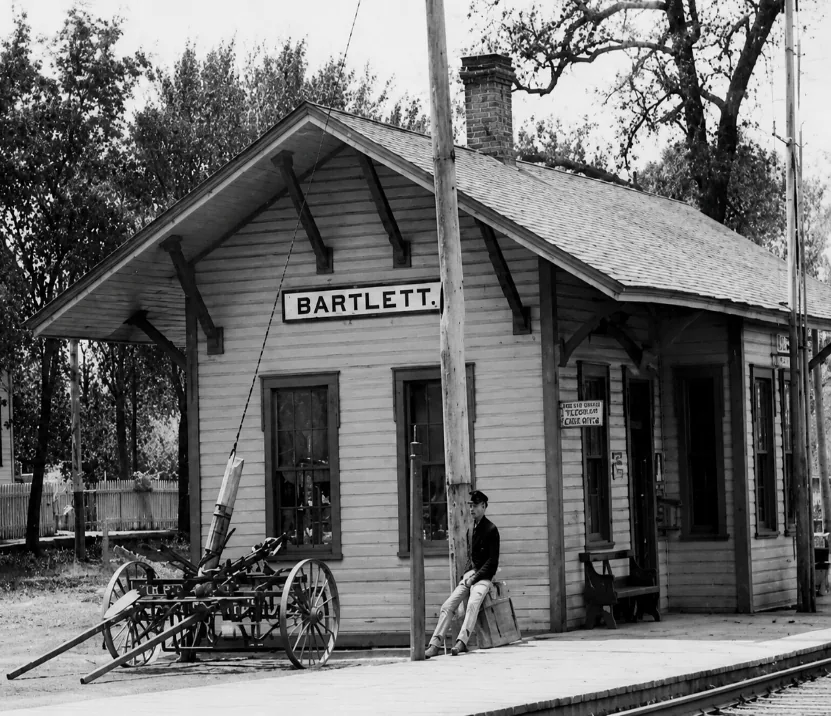
Bartlett Train Station was built in 1873 to transport crops to Chicago.
Early Life
Ferdinand Weber was born in 1811 in Darmstadt, in the Grand Duchy of Hesse. Later records identify him as a farmer, and he likely lived in one of the rural districts surrounding the growing city, where families cultivated small farms in a region that had been settled for generations.Ferdinand married Engel Pfingsten around 1838. Over the next eight years, they had four daughters—Caroline, Sophia, Julia, and Augusta. The family lived in an agricultural society where land was limited and opportunities to expand a farm were increasingly scarce.Years later, Ferdinand’s daughters recalled that their father had come to America hoping to engage in “extensive farming.” The phrase suggests that Ferdinand already knew what he wanted: not to abandon farming, but to find a place where farming could provide greater opportunity.
Why He Left
By the 1840s, population growth, limited farmland, economic difficulties, and political uncertainty were placing increasing pressure on families throughout the German states. For a farmer such as Ferdinand, hard work could maintain a family, but acquiring enough land to build a larger, independent farm was difficult.America offered a very different possibility. Reports of inexpensive and abundant farmland made it possible to imagine a future that Ferdinand could not easily achieve in Hesse.In 1848, Ferdinand and Engel made the decision to leave. With four young daughters, they gave up the familiarity of home, language, and community for the uncertain possibility of building something larger in America.
Journey to Illinois
Ferdinand, Engel, and their four daughters sailed from Bremen aboard the
Monterey
and arrived in New York on 27 September 1848. The passenger record indicates that their intended destination was Ohio, although it is not known whether this was a definite plan.Instead, the family eventually continued west to northern Illinois. Their journey would have required multiple forms of transportation as they traveled inland toward the developing agricultural regions of the Midwest.They settled in Hanover Township, near present-day Bartlett, where Ferdinand found what he had been seeking: open prairie and the possibility of farming on a scale he could only have imagined in Hesse.
Building a Life in Illinois
The Webers’ first years in Illinois were difficult. Ferdinand built a simple log cabin with a loft where the children slept. Family recollections described winter nights when snow blew through the roof and settled on their blankets. Outside waited another challenge—the thick prairie sod that had to be broken before crops could be planted.Yet the land rewarded their labor. By 1850, only two years after arriving in America, Ferdinand owned real estate valued at $800 and had 80 acres of improved land. The farm continued to expand.Ferdinand and Engel had no sons. Their daughters therefore became important participants in the farm’s development, helping with planting, harvesting, livestock, and other physical work. As the operation grew, Ferdinand also employed hired farm laborers.By 1860, the farm included 120 improved acres and was valued at $3,000, with another $1,000 in personal property. Ten years later, Ferdinand’s real estate was valued at $8,000. He continued acquiring and improving property and eventually purchased five lots in the growing town of Bartlett.By 1880, Ferdinand had retired from farming and moved into Bartlett with Engel. The immigrant farmer who had come to America hoping to practice “extensive farming” had accomplished what he set out to do.Ferdinand died on 22 December 1882. His will distributed the property he had accumulated among his daughters, providing financial security for the family whose labor had helped him build it.
Migration Timeline
This timeline shows the migration path to Illinois of Ferdinand Weber.
| Name | Date | From | To |
|---|---|---|---|
| Ferdinand Weber, Engel Pfingsten | Darmstadt, Hesse, Germany Confederation | 1848 | Hanover twp., Cook, Illinois |
Why This Story Matters
Ferdinand Weber’s story could easily be told as a conventional immigrant success story: a farmer leaves Germany, comes to America, acquires land, works hard, and becomes prosperous. But what makes his story more interesting is the deliberate way he pursued a very specific goal.Ferdinand did not come to America hoping vaguely for a better life. According to the memories passed down by his daughters, he wanted to engage in “extensive farming.” He already possessed agricultural knowledge and experience. What he lacked in Hesse was the land on which to use them on the scale he envisioned.Ferdinand’s story reminds us that immigrants brought ambitions with them as well as skills. America did not create Ferdinand Weber’s work ethic or his knowledge of farming. It gave him room to put them to greater use. What transformed that opportunity into prosperity was decades of disciplined work, careful decisions, and shared family effort.Illinois provided the opportunity, but opportunity alone did not create Ferdinand’s success.By the end of his life, Ferdinand had achieved the goal that had helped draw him across the Atlantic. More importantly, his will shows that the property he accumulated became security for his daughters—the same daughters who had crossed the ocean with him or been born into the family’s early years on the Illinois prairie.
Source Documents
The research documents for the Weber 1848 migration story:
- Biographical Sketch (PDF)
- Migration to Illinois (PDF)
- Genealogical Summary and Children (PDF)
- Legacy (PDF)
Related Reading
- Weber, Engel (Pfingsten)
- Weber Migration Story
- Paths to Illinois, Volume II The Davis Family Story
- Migration Timeline of all sixteen families
- Ancestors & Surnames index
My Blog and Newsletter have additional stories and research related to the Weber family.