
Walter Hebden Wilson (1782-1867)
Glasgow, Lanarkshire, Scotland → St. Charles, Kane County, Illinois
Glasgow baker who left Scotland for inexpensive land on the Illinois frontier.
Quick Facts
- Born: 20 January 1782, East Kilbride, Scotland
- Died: 15 June 1867, St. Charles, Kane County, Illinois
- Spouse: Janet Russell
- Occupation: Baker and Farmer
- Illinois Settlement: St. Charles, Kane County
Connection to Author: 3rd great-grandfather (Davis line)
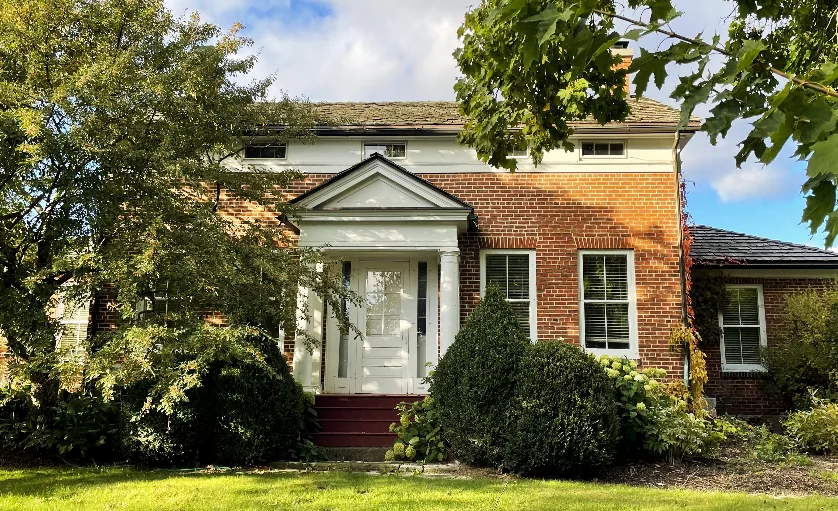
House Walter Wilson built in 1844, Photo 2023.
Early Life
Walter Wilson was born on 20 January 1782 in East Kilbride, Scotland, a rural community about ten miles from Glasgow. He grew up in a large family. Although his father’s occupation is unknown, by 1807 Walter had secured an apprenticeship as a baker, learning a skilled trade that would provide his livelihood for many years.
Walter married Janet Russell and eventually operated a commercial bakery in Glasgow. They had eight children, five of whom survived to adulthood. By the 1830s, Walter had built a life very different from the one he would eventually encounter on the Illinois prairie.
Why He Left
During the early 1830s, Glasgow experienced a cholera epidemic, which may have affected Walter’s bakery business as well as the family’s sense of security. At the same time, two of his children had already gone to Illinois. His daughter Margaret and son John had migrated to Jacksonville, where Margaret’s husband worked at Illinois College.
Margaret wrote home describing the opportunities she found in Illinois and eventually sent money to help the rest of the family make the journey. Faced with the possibility of beginning again near his children, Walter decided to leave Scotland and take his chances in America.
Journey to Illinois
In 1834, Walter and Janet left Liverpool aboard the Louise with their children Helen and John C. The transatlantic voyage by sailing vessel would have taken weeks and was only the first stage of their journey.
After arriving in New York, the family continued west toward Illinois. John remained in Chicago, where he worked as a baker and earned money, while Walter, Janet, and Helen traveled to Jacksonville to spend the winter with Margaret and her family.
Building a Life in Illinois
Walter and his son John eventually went north in search of federal land in Kane County. After locating 160 acres, they began establishing a farm and building a cabin. Janet and Helen soon joined them, and the family began the difficult process of creating a home on the Illinois prairie.
The primitive conditions were particularly difficult for Janet. In 1843, Walter began constructing a substantial new house, making bricks himself and producing additional bricks that could be bartered for other necessities. Janet died before the house was completed in 1845.
Walter continued developing the property into a productive farm. In 1855, he deeded the farm to his son John and spent his remaining years living with him. Walter died on 15 June 1867, more than three decades after leaving Scotland for an uncertain future in Illinois.
Migration Timeline
This timeline shows the migration path to Illinois of Walter Wilson.
| Name | Date | From | To |
|---|---|---|---|
| Walter Wilson, Janet, Hellen, John C. | Scotland | 1834 Chicago 1836 St. Charles |
St. Charles, Kane, Illinois |
Why This Story Matters
Walter Wilson’s story is about more than an immigrant who came to Illinois, acquired inexpensive federal land, and built a successful farm. It is also a story of adaptability—of taking the skills and knowledge acquired in one life and finding ways to use them in another.
Walter had trained as a baker before coming to Illinois, a background that might seem to have little connection to life on the prairie. Yet he brought practical skills with him. He made bricks for his own house and produced additional bricks that could be bartered for things his family needed. On a frontier where cash was scarce and many necessities had to be made rather than purchased, the ability to create something useful had real value.
Walter also recognized the opportunity offered by inexpensive federal land. He acquired 160 acres and, working with his son, transformed the prairie into a productive farm. His success was not simply the result of finding cheap land. It required adapting what he already knew, learning what an unfamiliar environment demanded, and making use of the resources and opportunities around him.
Walter’s story reminds us that immigrants did not arrive empty-handed. They carried knowledge, skills, resourcefulness, and experience with them. Those less visible possessions could be every bit as important as the land they eventually owned.
Source Documents
The research documents for the Wilson 1834 migration story:
- Biographical Sketch (PDF)
- Migration to Illinois (PDF)
- Genealogical Summary and Children (PDF)
- Legacy (PDF)
Related Reading
- Wilson, Janet (Russell)
- Wilson Migration Story
- Paths to Illinois, Volume II The Davis Family Story
- Migration Timeline of all sixteen families
- Ancestors & Surnames index
My Blog and Newsletter have additional stories and research related to the Wilson family.