
Andreas Andrew Gruenewald (Greenwald) (1831-1872)
Oberfell, Rhineland, Prussia → Chicago, Cook County, Illinois
Young farmer who left Rhineland for job opportunities in Chicago.
Quick Facts
- Born: 21 May 1831, Oberfell Boppard, Rheinland, Prussia
- Died: 30 September 1872, Chicago, Cook, Illinois
- Spouse: Susanna Prieb
- Occupation: Laborer, Saloon Keeper
- Illinois Settlement: Chicago
Connection to Author: 3rd great-grandfather (Jepson line)
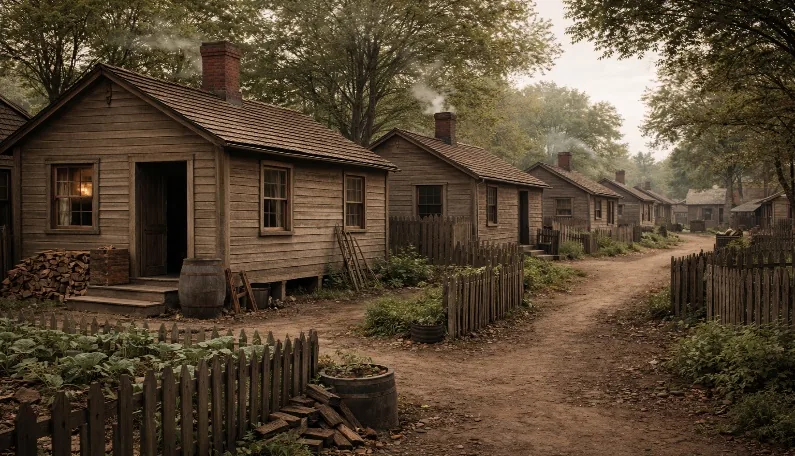
The kind of home the Gruenewald’s purchased in Chicago in the 1860s, based on historical descriptions. By ChatGPT.
Early Life
Andreas “Andrew” Gruenewald was born on 21 May 1831 in Oberfell in the Rhineland. Details of Andrew’s childhood have not survived, but he came of age during a period of considerable economic and political change.
The decades after the Napoleonic Wars had brought new political structures to the Rhineland, while economic pressures limited opportunities for many young people. The failed revolutions of 1848 were followed by political repression, and young men also faced compulsory military service. These circumstances formed the background to Andrew’s decision to leave, although no surviving record tells us precisely why he emigrated.
Why He Left
Around 1851, Andrew left the Rhineland for the United States. He was about twenty years old. For young men with limited prospects, emigration offered possibilities difficult to find at home: steady employment, greater personal independence, and the possibility of eventually owning property.
Chicago was becoming an especially attractive destination.
Its population was expanding rapidly, creating enormous demand for labor. At the same time, its growing German population meant that immigrants could find German-speaking churches, neighborhoods, businesses, and social networks.
Andrew could seek economic opportunity without immediately giving up the language, religion, and community life he had known in the Rhineland.
Journey to Illinois
No passenger list has yet been identified for Andrew, so the details of his journey remain unknown.
He likely followed one of the established emigrant routes from the Rhineland to a North Sea port before crossing the Atlantic. How he traveled from his American port of arrival to Chicago has also not been documented.
What the records establish is that Andrew reached Chicago during the early 1850s. There he joined thousands of other German immigrants who were becoming an important part of the rapidly growing city.
Building a Life in Chicago
Andrew’s life changed again when he met Susanna Prieb, another immigrant from the Rhineland. Susanna had been born in Mittelstrimmig, not far from Andrew’s home region. She had immigrated with her mother and siblings in 1855.
There is no evidence that Andrew and Susanna knew one another in Germany. Instead, two separate migrations from neighboring Rhineland communities brought them to the same German Catholic world in Chicago.
They married about 1859.
By 1860, Andrew and Susanna were living in Chicago’s Tenth Ward with their first child. Andrew worked as a laborer.
The census recorded that the young couple owned $600 in real estate. Only about nine years after Andrew’s immigration, he had moved from being a newly arrived young man to a married father and property owner.
During the 1860s, Andrew and Susanna continued building their family, with a total of six children. Andrew then changed occupations and became a saloon keeper. Things seemed to be going well, and then the family’s progress ended abruptly.
Andrew died in Chicago on 30 September 1872, at only forty-one years old.
He left Susanna with several young children.
Migration Timeline
This timeline shows the migration path to Illinois of Andreas Andrew Gruenewald.
| Name | Date | From | To |
|---|---|---|---|
| Andreas Andrew Gruenewald (1831-1872) | 1851 | Oberfell, Rhine Province, Prussia, German Confederation | Chicago, Cook, Illinois |
Why This Story Matters
Andrew’s story reveals a dark side of nineteenth-century immigrant success: stability could be built quickly, but it could also disappear with equal speed.
Andrew Gruenewald’s story reminds us that an immigrant’s achievement cannot always be measured by the wealth accumulated over a lifetime. Sometimes it is better measured by how much of a foundation could be built in the time available.
Andrew could not control how long he had to establish himself in America. What he did accomplish was to create a beginning strong enough for his family to continue after him.
Source Documents
The research documents for the Greenwald 1851 migration story:
- Biographical Sketch (PDF)
- Migration to Illinois (PDF)
- Genealogical Summary and Children (PDF)
- Legacy (PDF)
Related Reading
- Gruenewald (Greenwald), Susanna (Prieb)
- Gruenewald Migration Story
- Paths to Illinois, Volume I The Jepson Family Story
- Migration Timeline of all sixteen families
- Ancestors & Surnames index
- Gruenewald Migration Story
- Paths to Illinois, Volume I The Jepson Family Story
My Blog and Newsletter have additional stories and research related to the Gruenewald family.