
Sidney W. Hardy (1826-1885)
Orleans, Jefferson County, New York → Shabbona, DeKalb County, Illinois → Burlington, Kane County, Illinois
Adventurous young man who repeatedly pursued new opportunities before finally putting down roots with his family in northern Illinois.
Quick Facts
-
Born: 18 March 1826, Orleans, Jefferson County, New York
-
Died: 23 November 1885, Burlington, Kane County, Illinois
- Spouse: Lydia Helen Lott
-
Occupation: Ironworker, whaler, miner, merchant, farmer
- Illinois Settlement: Shabbona, DeKalb County and Burlington, Kane County
Connection to Author: 2nd great-grandfather (Davis line)
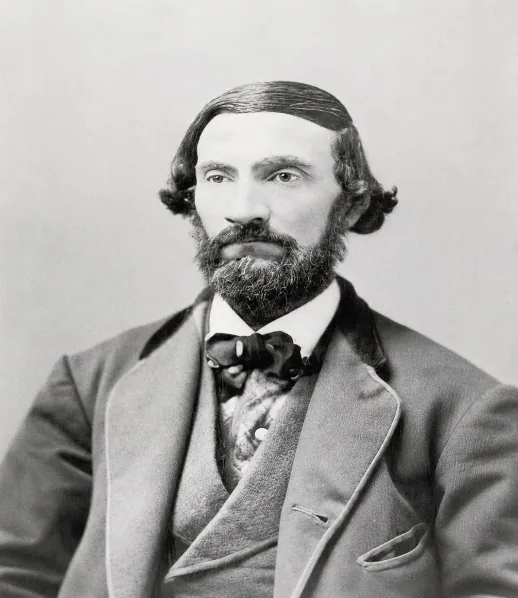
Sidney Hardy, date unknown.
Early Life
Sidney W. Hardy was born on 18 March 1826 in Orleans, Jefferson County, New York, the youngest of ten children of Gideon Hardy and Abigail Burnham. When Sidney was still a toddler, the family moved to Brownville, a growing community on the Black River near Lake Ontario.
Sidney’s father was a carpenter, while several of his older brothers became farmers. Sidney chose a different path. At sixteen, he was apprenticed to learn the iron trade at Skinner & Davis in Brownville. After completing his apprenticeship, however, he did not settle into the trade. At eighteen, he traveled to New Bedford, Massachusetts, and signed aboard the Liverpool II as a greenhand on a whaling voyage that would keep him at sea for nearly three years.
Why He Left
Sidney’s decision to leave Michigan for Illinois was only one of many times he pursued opportunity somewhere new.
After returning from whaling, he worked briefly as a welder, but the discovery of gold in California soon captured his attention. In 1849, Sidney sailed around Cape Horn to California. Mining produced little gold, so he and several partners opened a supply store before Sidney returned to New York in 1851.
Sidney then tried a very different path. He purchased a 123-acre farm in Carlton, New York, and in 1854 married Lydia Helen Lott. Despite respectable harvests, weather, pests, unstable markets, and a substantial mortgage made the farm unprofitable. Eventually, Sidney and Lydia sold the property. They spent about a year in Michigan and then decided to buy land in Illinois.
Once again, Sidney looked west for another opportunity.
Journey to Illinois
In 1857, Sidney and Lydia left New York with their young family and moved west. They spent time in Michigan, where Lydia had family, before continuing to northern Illinois.
By 1858, the Hardys had settled in Shabbona, DeKalb County. Their migration placed them among thousands of families from upstate New York who moved west during the nineteenth century in search of affordable farmland and greater economic opportunity.
For Sidney, however, the move was part of an even larger lifetime pattern: when one path failed to provide the future he sought, he was willing to try another.
Building a Life in Illinois
In Shabbona, Sidney returned to farming and initially experienced greater success than he had in New York. He and Lydia continued raising their growing family, although their years in Illinois were also marked by the deaths of young children.
The Civil War changed their lives again. In 1865, at age thirty-eight, Sidney enlisted in the Union Navy and served with the Mississippi Squadron. During his service, he became seriously ill with dysentery and was hospitalized in Memphis. Although he returned home later that year, his health never fully recovered.
Sidney sold his land in Shabbona and moved his family to Burlington, Kane County, near Lydia’s sister. He continued farming, but as his health declined, Lydia and other members of the family assumed more of the physical work.
Sidney and Lydia had nine children, six of whom survived to adulthood. Their youngest, Clarissa Helen “Nellie” Hardy, was born in Burlington in 1874.
Sidney died there on 23 November 1885 at the age of fifty-nine. He was buried at North Clinton Cemetery in Waterman, DeKalb County.
Migration Timeline
This timeline shows the migration path to Illinois of Sidney Hardy’s ancestors.
| Name | Date | From | To |
|---|---|---|---|
| Thomas Hardy (1605-1678) | 1630 | Westmorland, England With Gov. Winthrop |
Plymouth, MA |
| 1633 | Plymouth, MA | Ipswich, MA | |
| 1653 | Ipswich, MA | Rowley, MA | |
| 1663 | Rowley, MA | Bradford, Essex, MA | |
| Gideon Hardy (1722-1759) | 1744 | Bradford, Essex, MA | Tewksbury, MA |
| David Hardy (1746-1742) | 1790 | Wilmington, MA | Lyndeborough, New Hampshire |
| Gideon Hardy (1779-1851) | 1808 | Lyndeborough, New Hampshire | Greenfield, Hillsborough, New Hampshire |
| 1823 | Greenfield, Hillsborough, New Hampshire | Orleans, Jefferson, New York | |
| 1828 | Orleans, Jefferson, New York | Brownville, Jefferson, New York | |
| Sidney Hardy (1826-1885) | 1844-1847 | Circumnavigated the globe on a whaling ship | |
| 1847-1848 | Troy, New York | ||
| 1849 | Brownville, Jefferson, New York | San Franscisco, CA | |
| 1851 | Carlton, Orleans, New York | ||
| 1857 | Carlton, Orleans, New York | Ingham, Michigan | |
| 1858 | Ingham, Michigan | Shabbona, DeKalb, Illinois | |
| 1865 | Shabbona, DeKalb, Illinois | Burlington, Kane, Illinois |
Why This Story Matters
Sidney Hardy’s story reminds us that the people who settled Illinois were not all straightforward success stories. Opportunity involved risk, and risk sometimes ended in disappointment. Hard work did not guarantee prosperity. Sidney’s life is valuable precisely because it shows that less familiar side of the American migration story.
Sidney could be accused of not trying. He learned a skilled trade, spent nearly three years on a whaling ship, sailed around Cape Horn in search of California gold, became a merchant, purchased a farm in New York, moved west to try farming again in Illinois, and served in the Union Navy during the Civil War. Again and again, when one path failed to provide the security he sought, Sidney tried another.
Yet effort did not always bring reward. Whaling paid poorly. Gold mining produced almost nothing. His New York farm ended in financial difficulty. Military service damaged his health, and when Sidney died, he left little property and substantial debt.
Measured only by wealth, Sidney’s life might appear unsuccessful. But that measure misses something important. He and Lydia raised a family, established roots in northern Illinois, and created the stability from which later generations benefited. After generations of Hardy ancestors who repeatedly moved in search of opportunity, Sidney’s descendants finally remained.
His legacy was ultimately measured less in property than in the family and community that remained after him.
Source Documents
The research documents for the Hardy 1858 migration story:
- Biographical Sketch (PDF)
- Migration to Illinois (PDF)
- Genealogical Summary and Children (PDF)
- Legacy (PDF)
Related Reading
- How AI Broke Through My Writer’s Block (blog post)
- Hardy, Lydia Helen (Lott)
- Hardy Migration Story
- Paths to Illinois, Volume II The Davis Family Story
- Migration Timeline of all sixteen families
- Ancestors & Surnames index
My Blog and Newsletter have additional stories and research related to the Hardy family.