
Francis Hollister Kelsey (1797-1865)
Sheldon, Genesee County, New York → Cuba Twp., Lake County, Illinois
Young farmer who left New York for inexpensive land on the Illinois frontier.
Quick Facts
- Born: 14 March 1797, Sheldon, Genesee County, New York,
- Died: 3 October 1865, Cuba, Lake County, Illinois
- Spouse: Wealthy Susanna Ackley
- Occupation: Farmer
- Illinois Settlement: Cuba Twp., Cook County
Connection to Author: 4th great-grandfather (Jepson line)
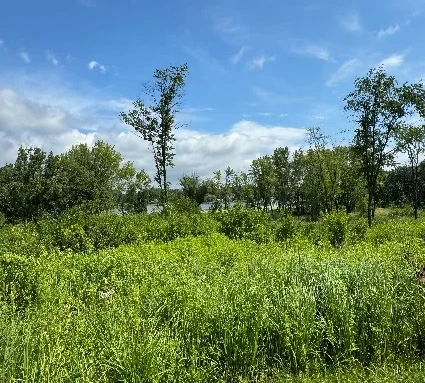
Photo of Kelsey property in Cuba Twp. 2024. Photo by author.
Early Life
Francis Hollister Kelsey was born on 14 March 1797 in Sheldon, Genesee County, New York, the youngest of three children of Samuel Joseph Kelsey and Betsey Hollister. Western New York was still a developing frontier during Francis’s childhood. His family had come from Connecticut, continuing a pattern of westward movement that had already carried several generations of Kelseys into newly developing communities.Francis grew up surrounded by the work of establishing and maintaining a farm. He also appears to have received some education and later was described as a “polished gentleman,” suggesting manners and social confidence that contrasted with our modern image of an isolated frontier farmer.The proximity of western New York to the Canadian border also placed Francis close to the events of the War of 1812. On 15 March 1812, at about fifteen years old, he enlisted as a volunteer.In 1823, Francis married Wealthy Susanna Ackley in Wales Center, Erie County, New York. Over the following years, they established their household primarily in Sheldon and had six children before leaving New York.
Why He Left
By the early 1840s, Francis and Susanna had spent nearly twenty years raising their family in western New York. Francis’s parents had died, their own family was growing, and land in the region was becoming increasingly expensive and divided. Illinois offered something increasingly difficult to obtain in New York: large amounts of fertile land at relatively low prices.Migration was also familiar within Francis’s family history. His ancestors had repeatedly relocated as older communities filled and opportunities for the next generation narrowed. Moving west was therefore not a rejection of stability. For families such as the Kelseys, migration could be a way of creating it.At forty-five, Francis decided to take that risk.
Journey to Illinois
Francis’s journey is unusually well documented. Details survive in his journal and in family papers. On 20 July 1842, Francis and Susanna left western New York with their six children and extended family members, including Susanna’s mother, Mary Holmes Ackley. They traveled west by wagon. On the third day, their youngest child, DeFores, fell from the wagon and was run over by a rear wheel. The family stopped while a physician treated him before continuing.Twenty days after leaving New York, they reached Chicago on 9 August. Their household goods, which had been shipped separately by water, had arrived safely. The journey was not yet over. The family continued to the Des Plaines River area, where illness soon became a problem. Susanna’s mother became seriously ill, and the family was advised to seek healthier conditions farther north. Francis moved his household up the Fox River into Lake County. There, near the small settlement of Cuba, he found available land and a place to establish his family’s new home.The entire wagon journey from New York to Illinois had taken twenty-two days.
Building a Life in Illinois
Francis quickly began turning migration into permanent settlement. In 1844, he purchased 160 acres near Cuba. That same year, Francis and Susanna welcomed their seventh child, Orville, the first of their children born in Illinois.The early years were not without tragedy. In 1849, their sixteen-year-old son Philetus died following a fall from a hay barn. Nevertheless, the farm continued to grow. By 1850, Francis’s real estate was valued at $1,200.Then he began expanding substantially. In 1854, Francis acquired another 350 acres. He purchased an additional 40 acres in 1856 and 44 more acres in 1858. By 1860, 200 acres of the farm were improved, and the agricultural census recorded a farm value of $2,400, along with livestock and farming equipment.What had begun as a risky move by a forty-five-year-old father with six children had become a substantial agricultural enterprise.Francis died on 3 October 1865. He was buried at White Memorial Cemetery in Cuba.
Migration Timeline
This timeline shows the migration path to Illinois of Francis Hollister Kelsey’s ancestors.
| Name | Date | From | To |
|---|---|---|---|
| William James Kelsey (1600-1680) | 1633 | Chelmsford, Essex, England | Cambridge, MA, Hartford, CT, Killingworth, CT |
| Stephen Kelsey (1677-1745) | 1717 | Hartford, CT | Weathersfield, CT New Hartford, CT |
| Samuel Joseph Kelsey (1756-1838) | 1789 Abt. 1796 |
New Hartford, CT Cambridge, Washington, NY |
Cambridge, Washington, NY Sheldon, Genesee, NY |
| Francis Hollister Kelsey (1797-1866) | 1842 | Sheldon, Genesee, NY | Cuba, Lake, Illinois |
Why This Story Matters
Francis Kelsey’s story illustrates an important distinction between taking a risk and simply being adventurous. He was not an unattached young man heading west to see what he might find. He was forty-five years old, married, and responsible for six children. He had already spent decades building a life in New York.
Moving to Illinois meant putting much of that established life at risk. The journey itself revealed how real the dangers were. Within days of leaving, a wagon wheel passed over his young son. After the family reached Illinois, illness followed. Even after they established their farm, the death of their son Philetus was a painful reminder that reaching their destination did not bring an end to uncertainty.
Yet Francis’s decision was not simply a willingness to take chances. He took a substantial risk for a specific purpose: the possibility of creating greater opportunity and security for his family. In Illinois, that risk ultimately paid off. He built a substantial farm, expanded his holdings over the following years, and created property that could be passed to his children.
For Francis, migration was the risk; permanence was the goal. His accomplishment was not simply reaching Illinois, but turning a dangerous journey into a place where his family could remain.
Source Documents
The research documents for the Kelsey 1842 migration story:
- Biographical Sketch (PDF)
- Migration to Illinois (PDF)
- Genealogical Summary and Children (PDF)
- Legacy (PDF)
Related Reading
- Kelsey, Wealthy Susanna (Ackley)
- Kelsey Migration Story
- Paths to Illinois, Volume I The Jepson Family Story
- Migration Timeline of all sixteen families
- Ancestors & Surnames index
My Blog and Newsletter have additional stories and research related to the Kelsey family.