Anne Fraser Fraser (1817-1893)
Knockbain, Invernessshire, Scotland → Rutland, Kane County, Illinois
Young woman who left Scotland with her family to join a Scottish community in Livingston County, New York.
Quick Facts
- Born: 8 April 1817 in Knockbain, Invernessshire, Scotland
- Died: 21 Dec 1893, Rutland, Kane County, Illinois
- Spouse: Thomas Alexander Fraser
- Occupation: Homemaker
- Illinois Settlement: Rutland, Kane County
Connection to Author: 3rd great-grandmother (Jepson line)
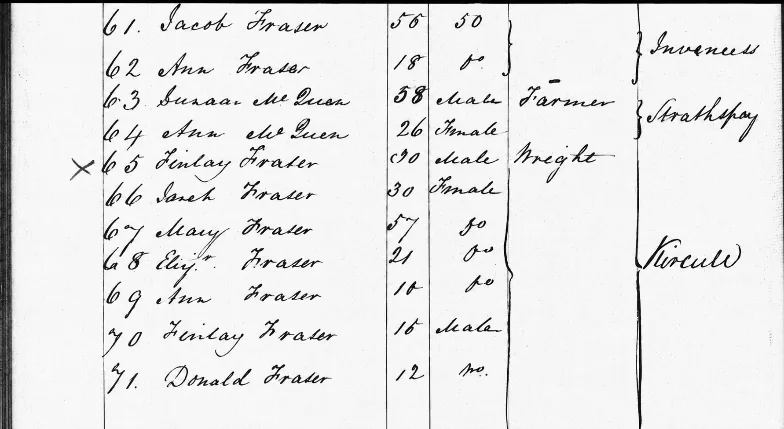
Passenger list for Anne and her family, 1835.
Early Life
Anne Fraser was born on 8 April 1817 in Knockbain, in the parish of Kirkhill, Inverness-shire, Scotland. She was the sixth of eight children of William Fraser and Isabelle MacLean.Anne grew up on the Black Isle near Reelick, in a rural Highland community overlooking the Beauly Firth. The area had long been associated with the Clan Fraser of Lovat and remained strongly influenced by Highland kinship, farming traditions, and Presbyterian faith.By Anne’s lifetime, however, the economic world of the Highlands was changing. Land was increasingly treated as a commercial asset, while rising rents and insecure tenancies made the future difficult for many farming families. Although Anne’s community did not experience the most dramatic Highland Clearances, it was affected by many of the same economic pressures.Her own family also experienced considerable loss. Three of Anne’s older brothers died young. Then, in 1834, her father died.
Why She Left
William Fraser’s death left the family in a more vulnerable position. That same year, Anne’s eldest surviving brother, William, emigrated to New York. He settled in Livingston County, where a well-established network of Scottish immigrants—including other Fraser families—already existed. In 1835, other members of the family followed him.Anne was eighteen when she left Scotland with her sister, Elizabeth, and younger brothers, Finlay and Donald. They traveled with other relatives, making their departure part of a family migration rather than an individual venture.For Anne, emigration offered the possibility of remaining connected to siblings while seeking opportunities no longer readily available to the family in Scotland.
Journey to Illinois
Anne migration had two parts. First, Anne left Greenock, Scotland, aboard the
John Hale
in 1835. The ship arrived in New York on 8 July 1835. From there, Anne continued to Livingston County in western New York, where her brother William was already living.She had crossed an ocean, but she did not enter an entirely unfamiliar social world.Livingston County contained a substantial Scottish community created in part by earlier migration from Inverness-shire. Family connections, familiar customs, and shared religious traditions provided continuity between the world Anne had left and the one she entered. There she met Thomas Alexander Fraser.Despite sharing a surname, Anne and Thomas came from different Fraser ancestral lines. Thomas had been born in New York to Scottish immigrant parents and had grown up within the Scottish community Anne had recently joined. They married in October 1839.Almost immediately, Anne was on the move again.Soon after their marriage, Thomas and Anne left New York for northern Illinois. Anne’s brother William traveled with them, and other relatives may also have been part of the group.Their precise route has not been documented. They likely used established transportation corridors connecting western New York with the Great Lakes and Chicago before traveling overland into Kane County.Within four years, Anne had left Scotland, crossed the Atlantic, established herself among relatives in New York, married, and moved again to the Illinois frontier.She was twenty-two years old.
Building a Life in Illinois
Thomas and Anne settled in Rutland Township among a small but growing Scottish community. There they had ten children.As their family grew, so did the farm.Thomas purchased forty acres in 1844 and continued expanding his holdings. By 1850, the family’s real estate was valued at $2,500. Additional land purchases followed during the 1850s.The household also endured repeated loss. Isabella died in infancy. Their eldest daughter, Mary, died in 1860 at twenty. Their son, William, died in 1863 after serving during the Civil War. Daniel died in 1878, and Anna Elizabeth died in 1873.By 1870, however, the farm Thomas and Anne had established was substantial. Thomas’s real estate was valued at $10,610, with more than two hundred acres under cultivation.Thomas died in 1882, leaving 275 acres valued at $14,500. He had made arrangements for the transfer of land to their children while providing for Anne’s support during her lifetime.Anne remained closely connected to her children and extended family for another eleven years. She died in Rutland Township on 21 December 1893. She was buried beside Thomas at Memorial Washington Reformed Presbyterian Cemetery, within the Scottish religious community that had remained part of their lives in Illinois.
Migration Timeline
This timeline shows the migration path to Illinois for Anne Fraser.
| Name | Date | From | To |
|---|---|---|---|
| Anne Fraser (1817-1893) | 1835 1839 |
Reelick, Kirkhill, Inverness, Scotland Livingston County, New York |
Livingston County, New York Rutland, Kane, Illinois |
Why This Story Matters
Anne Fraser’s story reminds us that migration was not always a story of leaving family behind. Sometimes family was the very network that made leaving possible. Anne’s experience illustrates something important about nineteenth-century migration: people could move great distances without moving entirely alone.Kinship networks reduced some of the uncertainty. They provided information about destinations, traveling companions, places to stay, potential marriage partners, assistance in establishing farms, and familiar communities after arrival.Those networks did not make migration easy. Anne crossed an ocean, left the landscape of her childhood, made another major journey while apparently heavily pregnant, raised ten children, and experienced the deaths of several of them.But she did not have to sever her past in order to create a future.Elements of the world Anne knew in Inverness-shire—family connections, Scottish neighbors, Presbyterian faith, and mutual support—were recreated first in New York and then in Illinois.
Source Documents
The research documents for the Fraser 1839 migration story:
- Biographical Sketch (PDF)
- Migration to Illinois (PDF)
- Genealogical Summary and Children (PDF)
- Legacy (PDF)
Related Reading
- Fraser, Thomas Alexander
- Fraser Migration Story
- Paths to Illinois, Volume I The Jepson Family Story
- Migration Timeline of all sixteen families
- Ancestors & Surnames index
My Blog and Newsletter have additional stories and research related to the Fraser family.